
Link equity is the currency of the web. Every high-quality external backlink acts as a deposit into your site’s central authority bank, but how you spend that capital determines whether your high-value commercial pages rank on page one or languish on page ten. If you treat internal linking as a secondary task, you are likely hemorrhaging the very power you worked so hard to acquire through outreach and content creation. Understanding the core concept of what link equity actually is will help you manage its flow more effectively.
To maximize organic performance, you must view your website not as a collection of isolated pages, but as a directed graph where authority flows from high-power nodes to strategic targets. This process, often referred to as PageRank distribution, is the mechanical foundation of topical authority. This concept is fundamental to grasping how link equity flows across your site and impacts rankings.
The Mechanics of PageRank and Authority Decay
While Google’s original PageRank algorithm has evolved, the core principle remains: authority is a finite resource. When a page receives a link, it inherits a portion of the linking page’s power. This power is then divided among all the outbound links on that page. If a page has 100 internal links, each link carries significantly less weight than if the page only had five links.
How the Number of Outbound Links Dilutes Value
Every link added to a page acts as a "leak" for that page’s total equity. This is particularly problematic in "mega-menus" that contain hundreds of links. When your homepage—usually your most authoritative page—links to every single category, subcategory, and utility page (like "Terms of Service"), it dilutes the equity sent to your primary money pages. To maintain a strong flow, you must prioritize links to pages that actually require ranking power to drive revenue.
The Damping Factor and Link Distance
Authority does not travel infinitely without loss. SEO professionals refer to this as the "damping factor." Each "hop" a user or crawler takes from the homepage reduces the amount of equity passed. A page buried four clicks deep in your architecture will receive a fraction of the authority compared to a page linked directly from the root domain. If your high-margin product pages are hidden behind deep pagination or complex filtering, they are effectively starving for equity.
Architecting for Topical Authority
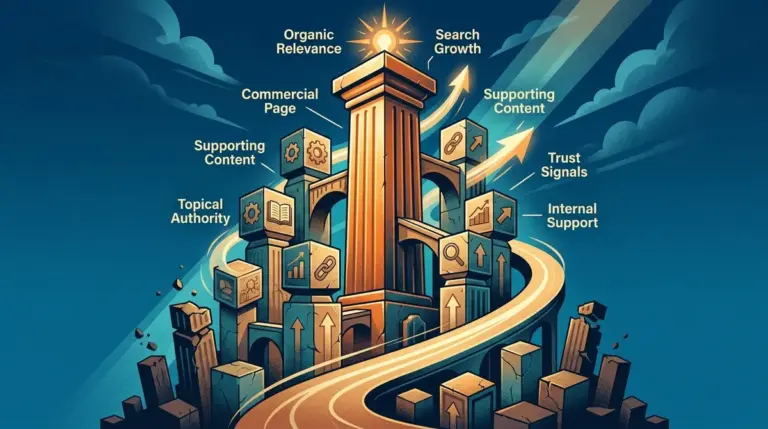
Topical authority is built by clustering related content and ensuring equity flows within those clusters. This signals to search engines that your site is not just a generalist, but a deep resource on a specific subject. By using a hub-and-spoke model, you can concentrate authority where it matters most.
- Pillar Pages (Hubs): These are broad, high-level guides that target high-volume keywords. They should receive the bulk of your external backlinks.
- Supportive Content (Spokes): These are specific articles that answer niche questions. They link back to the pillar page to reinforce its authority.
- Cross-Linking: Spokes within the same cluster should link to each other to keep equity circulating within the relevant topic rather than leaking out to unrelated sections of the site.
Warning: Avoid "orphaned pages"—content that has no internal links pointing to it. Even if an orphaned page has strong external backlinks, its inability to pass that equity back into your site’s ecosystem limits your overall domain strength and makes the page harder for crawlers to index reliably.
Plugging the Leaks in Your Link Graph
Before building new links, you must audit your current structure to ensure you aren't wasting existing authority. Technical debt is often the primary cause of equity stagnation. If your internal links point to 404 pages or through long redirect chains, you are losing a percentage of power at every step.
Redirect Chains: Every time a link passes through a 301 redirect, there is a minor loss of equity. If a link passes through three redirects before hitting a live page, the authority loss becomes measurable. Audit your site for internal links that point to old URLs and update them to point directly to the final destination.
Broken Internal Links: A link to a 404 page is a dead end. The equity goes nowhere. Use a crawler to identify these broken links and either restore the page or redirect the link to a relevant, live alternative.
The "Nofollow" Fallacy: In the past, SEOs used "PageRank Sculpting" by nofollowing internal links to utility pages. Modern search engines are smarter; nofollowing an internal link doesn't "save" that equity for other links; it simply causes that portion of equity to disappear. Instead of nofollowing, remove the link entirely or move it to a section of the page (like the footer) where it carries less weight than primary body links.
Tactical Equity Redistribution for Conversion Pages
Most external links naturally point to informational content—blog posts, research, or tools. However, these aren't usually the pages that generate direct revenue. To rank your commercial "service" or "product" pages, you must bridge the gap between your informational assets and your commercial assets.
Identify your "Power Pages"—the articles on your site with the highest number of referring domains. These pages are your internal engines. By adding a contextual, high-relevance link from a Power Page to a related commercial page, you can "push" authority directly to the URLs that need it most. This is more effective than site-wide sidebar links because contextual links within the main body content are weighted more heavily by ranking algorithms.
Maximizing the Value of Every Internal Click
To turn link equity into a competitive advantage, stop treating internal links as navigation and start treating them as strategic assets. Focus on reducing the click depth for your most important pages and ensuring that every link uses descriptive, keyword-rich anchor text. This not only passes authority but also provides the necessary context for search engines to understand what the target page is about. Regularly audit your link graph to remove redundant links and fix technical errors that bottleneck your site's power. Authority is hard to earn; make sure every drop of it is working toward your bottom line.
Frequently Asked Questions
Does the location of a link on a page matter?
Yes. Links within the main body content (contextual links) generally pass more equity than links in the header, footer, or sidebar. Search engines prioritize links that are likely to be part of the editorial content and relevant to the user's current intent.
How many internal links are too many?
There is no hard limit, but the more links you have on a page, the less equity each individual link carries. Aim for a natural, user-centric approach. If a page is cluttered with links, it dilutes the authority flow and creates a poor user experience.
Should I use the same anchor text for every internal link?
While you want to use descriptive keywords, variety is important. Using the exact same anchor text for every single internal link can look manipulative. Use variations that reflect the topic of the target page while remaining natural within the context of the surrounding text.