

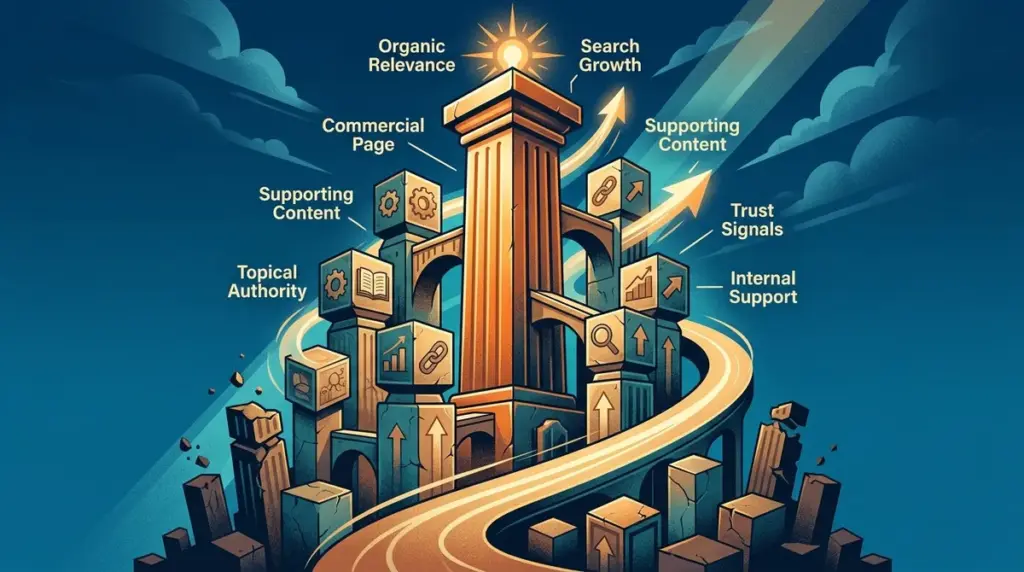
Ranking a commercial page—whether it is a product category, a service landing page, or a high-intent "best of" list—requires more than just high-quality backlinks and clean technical SEO. In the current search landscape, Google prioritizes topical authority. If your site only features "Buy Now" pages without the surrounding context that proves your expertise, your rankings will hit a ceiling. Supporting content acts as the structural integrity for your commercial assets, providing the semantic depth and internal link equity necessary to signal to search engines that you are a definitive source in your niche. This structure is key to building topical authority, so consider how to structure content clusters for better authority flow.
Identifying the Informational Gaps in Your Commercial Funnel
To reinforce a commercial page, you must first identify what a user needs to know before they are ready to convert. If you are targeting a high-competition keyword like "enterprise fleet management software," a standalone sales page is rarely enough. Search engines look for a cluster of related information that addresses the user's broader intent.
Best for: Identifying gaps by analyzing the "People Also Ask" (PAA) boxes and the bottom-of-page related searches for your primary commercial keyword. These are the immediate informational requirements Google has already associated with your target topic.
Supporting content should not be generic blog posts. It must be strategically mapped to the buyer’s journey. For every commercial page, aim to produce at least three to five informational pieces that tackle different stages of the funnel:
- The Problem-Aware Stage: Content that defines the pain point your product or service solves (e.g., "Why fleet maintenance costs are rising in 2024").
- The Comparison Stage: Content that evaluates different methodologies or categories (e.g., "Telematics vs. Manual Logbooks: A Cost-Benefit Analysis").
- The Technical/Execution Stage: Content that explains how to implement or use a solution (e.g., "How to integrate GPS tracking with existing ERP systems").
Engineering Internal Link Equity for Maximum Relevance
The primary function of supporting content is to pass "link juice" and topical relevance to your money pages. However, a haphazard internal linking strategy can dilute your efforts. You must treat your commercial page as the "hub" and your supporting articles as the "spokes."
The Power of Descriptive Anchor Text
Avoid generic "click here" or "learn more" anchors. When linking from a supporting article to a commercial page, use descriptive, keyword-rich anchor text that tells the crawler exactly what the destination page is about. If your supporting post is about "optimizing warehouse workflows," and it links to your "warehouse management software" page, use that exact phrase or a close variant. This reinforces the semantic connection between the informational problem and the commercial solution.
Warning: Avoid "Internal Cannibalization." If your supporting informational page is too optimized for the commercial keyword, it may outrank your sales page. Ensure the informational page targets "how-to" or "what is" intent, leaving the "best" and "service" intent for the commercial asset.
The Reverse Silo Method
While traditional silos push authority down from the homepage, the reverse silo pushes authority up from deep informational pages. When you publish a high-value guide that naturally earns external backlinks, that authority flows directly to your commercial page via the internal links you’ve placed. This makes your commercial pages more resilient to algorithm updates because their authority is built on a foundation of genuine informational value rather than just manufactured redirects.
Content Types That Convert Traffic into Trust Signals
Not all supporting content is created equal. To reinforce a commercial page effectively, the content must demonstrate E-E-A-T (Experience, Expertise, Authoritativeness, and Trustworthiness). Google’s Quality Rater Guidelines emphasize that for YMYL (Your Money Your Life) topics, the surrounding context is vital.
Case Studies and Proof Points: These are the strongest forms of supporting content. A case study detailing how a client used your service to achieve a specific ROI provides a concrete reason for Google to trust your commercial claims. It moves the page from "marketing copy" to "verified solution."
Glossaries and Resource Hubs: Creating a glossary of terms related to your industry allows you to capture hundreds of low-volume, high-intent long-tail keywords. Each of these glossary terms can link back to your main service pages, creating a dense web of topical relevance that is difficult for competitors to replicate without significant effort.
Auditing for Intent Overlap and Keyword Decay
Supporting content is not a "set it and forget it" tactic. Over time, the intent of a keyword can shift. A query that used to trigger informational results might start showing commercial results, or vice versa. Regularly audit your supporting clusters to ensure they are still serving their primary purpose: reinforcing the commercial hub.
If you find that an informational post has high traffic but a high bounce rate and no click-throughs to your commercial page, the content is likely too broad. Refine the copy to lead more naturally into the commercial solution. Conversely, if a supporting page starts ranking for your commercial terms, you must de-optimize the informational page’s metadata to ensure the "money page" regains its position.
Executing Your Cluster Strategy
To turn these concepts into a repeatable workflow, start by auditing your top three commercial pages. Identify the primary keyword for each and map out five specific questions a buyer would ask before making a purchase. Produce those five pieces of content, ensuring each one contains a prominent, contextually relevant internal link back to the commercial hub. Monitor the "Impressions" metric in Google Search Console for the commercial page; as the supporting cluster gains traction, you should see a correlated rise in the commercial page's visibility, even before its direct rankings improve. This indicates that Google is beginning to recognize your site’s topical authority.
Supporting Content FAQ
How many supporting articles do I need for one commercial page?
There is no magic number, but a minimum of three to five high-quality articles is usually required to establish a basic topical cluster. For highly competitive industries, you may need 20 or more pieces of supporting content to demonstrate sufficient authority to outrank established incumbents.
Should I link between supporting articles or only to the commercial page?
You should do both. Linking between supporting articles (lateral linking) helps crawlers discover your entire cluster more efficiently. However, the majority of your internal link equity should be directed upward toward the commercial "hub" page to ensure it remains the most authoritative page in the cluster.
Can I use AI to generate supporting content?
You can use AI for outlining and initial drafts, but supporting content must contain unique insights, data, or experience to be effective. Google’s "Information Gain" patent suggests that content adding nothing new to the index is valued less. Ensure your supporting content includes proprietary images, original examples, or unique expert commentary to maximize its impact.
Does the supporting content need to be on the same subfolder?
While it is not strictly necessary for SEO, keeping your cluster within a logical URL structure (e.g., /blog/topic-name/ and /services/topic-name/) helps both users and search engines understand the relationship between the pages. The most important factor, however, is the internal linking structure, not the URL string itself.