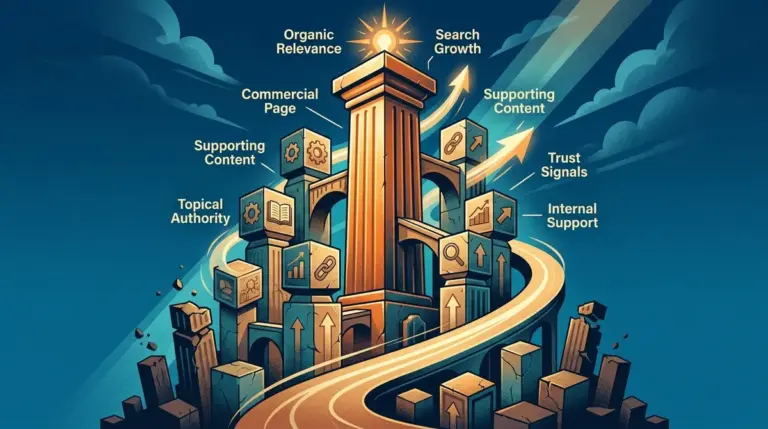

Link equity is the quantified value that one page passes to another through hyperlinks. In the early days of search, this was known purely as PageRank, a mathematical formula calculating the importance of a page based on the quantity and quality of links pointing to it. Today, link equity is more nuanced, incorporating topical relevance, user signals, and the structural integrity of the linking site. For SEO professionals and site owners, understanding link equity is the difference between a high-authority site that ranks for nothing and a strategically architected domain that dominates its niche. Understanding the difference between link equity and link juice is vital for effective SEO strategy.
The Architecture of Value Transfer
When a page links to another, it acts as a digital endorsement. However, not all endorsements carry the same weight. Link equity is a finite resource distributed across a page's outbound links. If a high-authority page links to ten different resources, each of those resources receives a fraction of the available equity. If that same page links to only one, the concentration of value is significantly higher.
Primary factors determining equity transfer:
- Topical Relevance: A link from a high-authority medical journal to a healthcare provider carries significantly more equity than a link from a generic lifestyle blog, regardless of the latter's raw traffic metrics.
- Link Placement: Links embedded within the main body content (editorial links) pass more equity than links relegated to the footer, sidebar, or navigation menus, which search engines often discount as "boilerplate."
- Crawlability and Indexability: If a page is blocked by robots.txt or tagged with "noindex," it cannot accumulate or pass equity. Similarly, links with the
rel="nofollow"attribute are explicitly instructed not to pass ranking credit. - Link Status: Broken links (404s) or links pointing through long redirect chains lose a percentage of their original equity. A direct 200-OK link is the gold standard for value retention.
Internal Link Equity: The Lever for Topical Authority
While external backlinks are the primary drivers of site-wide authority, internal link equity is how you distribute that power to specific "money pages" or high-conversion assets. Most sites suffer from "equity leakage," where high-value pages link out to low-value administrative pages like "Terms of Service" or "Privacy Policy" with the same intensity as their primary service pages. This often requires a strategic approach to using supporting content to reinforce commercial pages.
Strategic Pruning and Redirection
To maximize internal equity, you must audit your internal link profile to ensure the "depth" of your most important pages is shallow. Pages buried four or five clicks away from the homepage rarely receive enough equity to rank for competitive terms. By flattening the site architecture and using descriptive, keyword-rich anchor text, you signal to search engines which nodes in your topical map are the most critical.
Pro Tip: Use a crawler to identify "orphan pages"—pages with zero internal links. These pages possess no equity and are virtually invisible to search engines, regardless of how good the content is. Reclaiming these pages by linking to them from high-authority "seed" pages can result in immediate ranking jumps.
The Role of Anchor Text in Equity Distribution
Anchor text provides the context that tells search engines what the destination page is about. While external anchor text is harder to control and should remain diverse to avoid over-optimization penalties, internal anchor text should be specific. Vague phrases like "click here" or "read more" waste the opportunity to pass topical equity. Instead, using "enterprise SEO strategies" or "link building for SaaS" helps the target page build relevance for those specific clusters.
Factors That Dilute or Block Equity
Equity is not a permanent asset; it can be diluted or blocked by technical mismanagement. One of the most common errors is the improper use of the rel="sponsored" or rel="ugc" tags on internal links, which can inadvertently signal to Google that the content is not an editorial endorsement.
Common equity killers include:
Excessive Outbound Links: Every additional link on a page dilutes the "slice" of equity given to the others. While outbound links to authoritative sources are good for trust, a page with 200 outbound links passes negligible value to any single one of them.
Redirect Loops and 302s: While Google has stated that 301 and 302 redirects now pass PageRank, 302s (temporary) do not update the index as efficiently as 301s (permanent). Multiple hops in a redirect chain (A to B to C) can lead to a measurable drop in the equity that finally reaches the destination.
Quantifying Link Equity Beyond Third-Party Metrics
Many marketers rely solely on Domain Rating (DR) or Domain Authority (DA) to judge equity. This is a mistake. These are third-party proxies, not Google's actual metrics. To truly judge the equity of a potential link source, you must look at its organic traffic trends. A site with a high DR but declining organic traffic is likely under a manual or algorithmic suppression, meaning the equity it passes is tainted or diminished. Real equity comes from sites that Google currently trusts and rewards with visibility.
Maximizing Your Site’s Ranking Power
To effectively manage link equity, begin with a site-wide audit of your external backlink profile. Identify the pages on your site that have the most high-quality external links—these are your "power pages." From these pages, strategically link to newer content or pages that are currently ranking on page two of search results. This "top-down" distribution of equity is the fastest way to move the needle without acquiring new external links.
Next, address technical debt. Fix 404 errors on pages that have existing backlinks. When a page with backlinks returns a 404, the equity it earned from the internet is effectively deleted. By 301 redirecting those dead URLs to the most relevant live page, you "recapture" that lost equity and immediately boost your site's overall authority.
Frequently Asked Questions
Does a link from a high-traffic page pass more equity than a low-traffic page?
Not necessarily. While traffic is a sign of trust, equity is primarily based on the authority of the domain and the relevance of the link. However, a link that actually gets clicked (referral traffic) provides additional user-behavior signals that can indirectly strengthen the ranking power of that link.
Do nofollow links have any value at all?
Nofollow links do not pass link equity in the traditional sense, meaning they won't help a page rank for a specific keyword through PageRank transfer. However, they are essential for a natural backlink profile and can drive traffic and brand awareness, which are secondary trust signals.
How long does it take for link equity to impact rankings?
Equity transfer is not instantaneous. Once a link is placed, search engines must crawl the linking page, process the new link, and then re-evaluate the destination page. This cycle typically takes anywhere from a few days to several weeks, depending on the crawl frequency of the sites involved.
Can too much internal linking hurt my site?
It is difficult to "over-link" internally from a penalty perspective, but you can certainly dilute your equity. If every page links to every other page, search engines cannot distinguish which content is the most important. Focus on a logical hierarchy rather than a flat, interconnected web.