

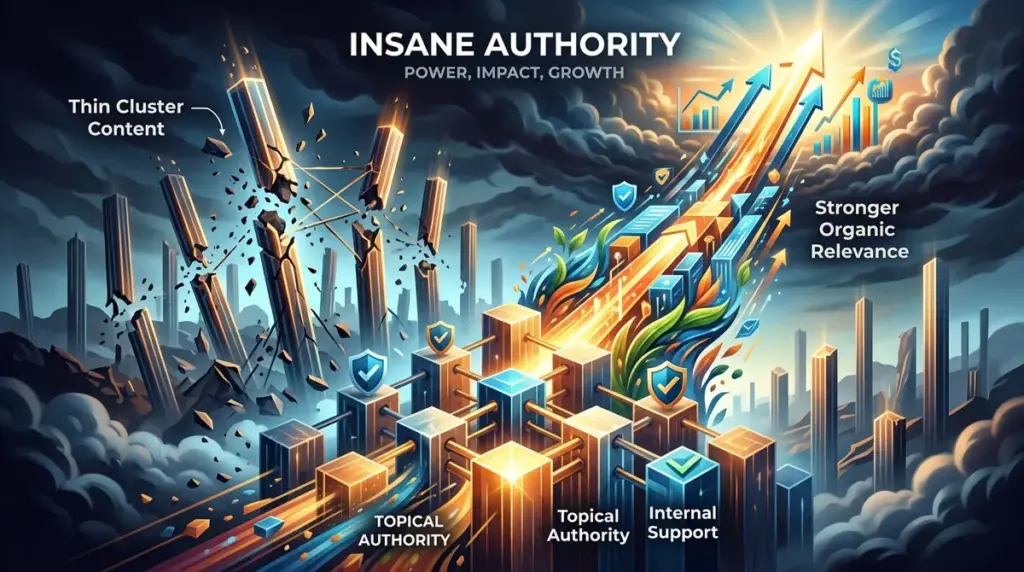
Topical authority is frequently sold as a volume game. The prevailing logic suggests that if you publish fifty articles around a core keyword, search engines will naturally view your domain as an expert. This is a strategic error that leads to "cluster bloat." When cluster content is thin—meaning it lacks unique information gain, fails to satisfy a specific intent, or merely repeats the pillar page—it does more than just fail to rank; it actively degrades the ranking potential of the entire topic. For agencies and publishers, thin clusters represent a sunk cost in production that yields a negative return on crawl budget and trust signals.
The Semantic Redundancy Trap
The primary reason thin cluster content fails is semantic redundancy. Google’s objective is to provide the most efficient path to an answer. If your pillar page covers "Commercial Real Estate Investing" and you create a cluster page for "Commercial Real Estate Investing Tips" that offers the same five bullet points found in the pillar's summary, you have created a redundant node.
Search engines use topic modeling to understand the breadth of a site. When multiple pages within a cluster target the same semantic space without adding new data, perspectives, or utility, the algorithm struggles to determine which page is the primary authority. This results in keyword cannibalization where the pillar and the cluster page fluctuate in the SERPs, preventing either from reaching the top three positions. To avoid this, every cluster page must justify its existence by answering a question the pillar page is too broad to address deeply.
The Failure of Information Gain
Information gain is a technical concept rooted in Google’s patent filings, suggesting that the engine prioritizes content that provides new information not found in other documents the user has already seen. Thin cluster content usually fails because it is "derivative." It summarizes the top three results on the SERP without adding proprietary data, expert quotes, or unique case studies.
Best for: Sites in YMYL (Your Money, Your Life) niches where "generic" advice is now viewed as a low-quality signal. If your cluster content looks like a rehashed version of a Wikipedia entry, it will likely be suppressed by the Helpful Content System.
Pro Tip: Before commissioning a cluster article, ask: "What does this page tell the user that the pillar page cannot?" If the answer is just "more detail," ensure that detail includes specific data points, localized nuances, or actionable templates that the pillar page lacks the space to host.
Crawl Budget and the Dilution of Link Equity
Internal linking is the nervous system of a content cluster. In a healthy model, cluster pages act as spokes that funnel authority back to the pillar (the hub). However, when clusters are thin, they become "dead ends." If a user lands on a thin page, finds no value, and bounces back to the SERP, it sends a negative signal regarding the site’s relevance.
- Internal Link Dilution: Every link from your pillar page to a thin cluster page is a waste of "link juice." You are essentially spending your site's hard-earned authority on pages that cannot convert or rank.
- Crawl Efficiency: Search engine bots have a finite amount of time to spend on your site. If they are busy indexing fifty low-value cluster pages, they may miss updates to your high-converting product pages or your primary pillar content.
- UX Friction: Users who click through a cluster to find "thin" content lose trust in the brand. This lowers the probability of them clicking a CTA or returning to the site via direct traffic.
Distinguishing Between 'Short' and 'Thin'
It is a common misconception that word count determines thinness. A 400-word page that provides a specific, proprietary calculator or a definitive answer to a technical "how-to" query is not thin. Conversely, a 2,000-word page filled with "fluff"—vague transitions, repetitive definitions, and AI-generated filler—is the definition of thin content.
Thinness is a measure of utility density. In a high-performing cluster, the length of the page should be proportional to the complexity of the sub-topic. If you are targeting a long-tail keyword like "tax implications of REITs for non-residents," the content must be dense with specific legal or financial facts. If that same page is 1,500 words but only says "taxes are important and you should talk to an accountant," it is thin content that will drag down the entire REIT cluster.
The Intent Mismatch in Cluster Strategy
Many SEOs build clusters based on keyword lists rather than intent maps. This leads to creating pages for keywords that Google already treats as synonymous. For example, if "SEO strategy" and "SEO plan" have 100% SERP overlap, creating two separate cluster pages is a mistake. This creates a "thin" experience because the engine sees them as the same intent. A successful cluster identifies distinct stages of the buyer’s journey—awareness, consideration, and decision—and ensures each page serves a unique stage without overlapping the others.
Auditing and Repairing Your Topical Architecture
To fix a failing cluster, you must be willing to prune. The goal is not to have the most pages, but the most authoritative coverage. This requires a cold-eyed assessment of your current sub-pages and their performance metrics beyond just "clicks."
First, identify cluster pages with high impressions but low click-through rates and high bounce rates. This often indicates that the meta-data promised an answer the thin content failed to deliver. Second, use a "content gap" approach within your own site. Compare your cluster pages to the top-performing competitors. If they have proprietary images, expert interviews, or downloadable assets and you only have text, your content is functionally thin.
Third, consider consolidation. If you have three thin pages covering closely related sub-topics, merge them into one "Power Cluster" page. This concentrates the link equity and creates a more comprehensive resource that is harder for competitors to displace. Redirect the old URLs to the new, consolidated version to preserve any existing backlink value.
Frequently Asked Questions
How many cluster pages do I need for a pillar page?
There is no magic number. You need exactly as many pages as there are distinct, high-volume intents within that topic. If a topic only has four distinct sub-angles, four high-quality pages will outperform ten thin ones every time.
Can AI-generated content be used for clusters?
Only if it is heavily edited for "Information Gain." Standard AI output tends to be the average of existing web content, which is the definition of thin, derivative material. Use AI for outlining, but use human experts for the data and insights that make the cluster valuable.
How do I know if my cluster page is too similar to my pillar page?
Check the SERP overlap. Search for both keywords. If the results are 70% identical, Google views the intent as the same. In this case, the cluster topic should be integrated into the pillar page rather than standing alone.
Does thin content affect my whole site or just that cluster?
While the most immediate impact is on the specific cluster, a high ratio of thin-to-useful content can lead to a sitewide "Helpful Content" suppression. Google evaluates the overall helpfulness of a domain; a few dozen thin pages can anchor your entire site’s growth.