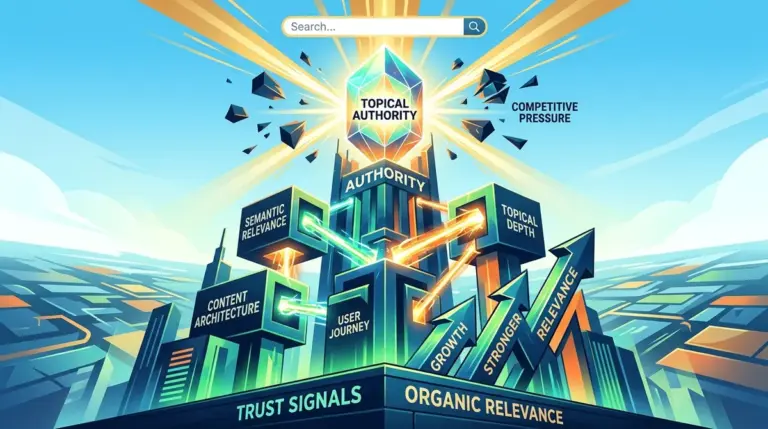


Local SEO has shifted from a game of citation volume and proximity to a battle for topical relevance. For years, small businesses could rank simply by being the closest physical entity to a searcher. Today, Google’s algorithm prioritizes the "knowledgeable neighbor"—the business that demonstrates deep expertise in both its service niche and its specific geographic environment. Topical authority for local businesses isn't about writing generic blog posts; it is about building a semantic web of content that proves you understand the localized nuances of your industry better than a national aggregator.
The Shift from Proximity to Entity-Based Local Search
Google no longer views a local business as just a set of coordinates. It views you as an entity. This entity is defined by its relationships to other entities: your services, your neighborhood, local regulations, and specific regional problems. If you are a roofing contractor in Miami, your topical authority isn't built by mentioning "roofing" and "Miami" repeatedly. It is built by publishing technical content on hurricane-rated shingles, salt-air corrosion, and Miami-Dade County building codes. This creates a high-density relevance signal that generic competitors cannot replicate.
Best for: Service-based businesses (HVAC, Legal, Medical) and multi-location brands looking to displace national directories in local SERPs.
Mapping the Local Topical Map
To dominate a local market, you must map out every sub-topic a customer might search for during their journey. This requires moving beyond "bottom-of-funnel" service keywords. You need to address the environmental and logistical realities of your specific service area. A landscaping company in Arizona should not write about general lawn care; they should build authority around xeriscaping, irrigation efficiency in desert climates, and local soil pH levels.
Granular Neighborhood Content
Broad city-level targeting is often too competitive. Topical authority is frequently won at the neighborhood or district level. By creating content that references specific local landmarks, historic districts, or neighborhood-specific architectural styles, you signal to search engines that your business is deeply integrated into the local fabric. This creates a "hyper-local" relevance that boosts your main service pages.
Addressing Regional Pain Points
Every location has unique stressors. Topical authority is built by solving these specific problems. For a basement waterproofing company in the Midwest, this means deep dives into the impact of "freeze-thaw cycles" on local foundation types. For a lawyer in New York, it means interpreting specific state-level legislative changes before the national firms catch up. This information-dense approach earns trust signals that generic "About Us" pages never will.
Warning: Avoid "cookie-cutter" location pages. Creating 50 pages for 50 suburbs with the exact same text—only swapping the city name—is a footprint for thin content. Google’s helpful content systems increasingly devalue these pages, often leading to a sitewide suppression of organic reach.
The Hub-and-Spoke Model for Local Dominance
The most effective structural strategy for local topical authority is the hub-and-spoke model. This involves a high-level "Money Page" (the Hub) supported by a cluster of informational, locally-nuanced articles (the Spokes). This structure allows you to pass internal link equity directly to the pages that drive conversions while satisfying the user’s need for information.
- The Hub: A primary service page (e.g., "Residential HVAC Repair in Chicago").
- The Spokes: Articles on "How Chicago Humidity Affects AC Lifespans," "Navigating Permit Requirements for Outdoor Units in Cook County," and "Common HVAC Failures During Chicago Polar Vortices."
- The Internal Link: Every spoke must link back to the hub using descriptive, varied anchor text that reinforces the primary service.
This method doesn't just help with rankings; it builds a moat. When a competitor tries to outrank you, they aren't just fighting one page; they are fighting an entire ecosystem of relevant information that Google trusts.
Technical Signals of Local Expertise
Topical authority is reinforced by technical data. For local businesses, this means leveraging Schema markup to connect your content to your physical location. Using LocalBusiness and Service schema is the baseline. To truly differentiate, use AreaServed and About properties to link your service pages to specific Wikipedia or Wikidata entries for your city and its sub-localities.
Furthermore, your internal linking should reflect a geographic hierarchy. Your "Service Area" main page should act as a directory that links to specific neighborhood hubs, which in turn link to hyper-local case studies or project reports. This creates a logical flow of relevance that search crawlers can easily categorize.
Leveraging Local Project Reports and Case Studies
One of the most underutilized assets for local topical authority is the "Project Report." Instead of a standard gallery page, create detailed posts about specific jobs in specific neighborhoods. For a contractor, this might be: "Restoring a Victorian Porch in the Historic North End."
These reports provide concrete evidence of your work while naturally incorporating local keywords and entities. They prove you are active in the community and provide "Proof of Work" that both users and search engines value. Include details about the specific materials used, the challenges posed by the local terrain, and the specific municipal codes followed. This is the definition of information-dense, commercially useful content.
Executing a Local Authority Sprint
To move the needle quickly, stop publishing generic "Top 10" lists. Your content calendar should be dictated by local search trends and seasonal regional issues. Follow this three-step execution plan to build your authority moat:
1. Audit for Information Gaps: Identify the technical questions your local customers ask that aren't answered on your site. Use your own sales data and customer emails to find these "long-tail" opportunities.
2. Build the Regional Context: Create at least five pieces of content that deal specifically with the intersection of your service and your local environment (weather, laws, geography).
3. Strengthen Internal Support: Ensure your "informational" blog posts are not dead ends. Every post should strategically link to a relevant service page or a "Get a Quote" page, using anchor text that reinforces your topical expertise.
By focusing on the depth of your local knowledge rather than the breadth of your keyword list, you build a site that is resilient to algorithm updates and more persuasive to human customers. Topical authority is the only sustainable way to win in a localized search environment that is increasingly crowded and sophisticated.
Frequently Asked Questions
Does topical authority help if I only have one physical location?
Yes. In fact, it is even more critical. A single-location business must prove it is the definitive expert for its specific area to compete with larger brands that have massive backlink profiles. Topical depth is your primary competitive advantage over "big box" competitors.
How long does it take to see results from a topical authority strategy?
While traditional SEO can take 6–12 months, local topical clusters often show movement within 3–4 months. Because you are targeting specific, low-competition local entities, Google can categorize and reward your relevance faster than it would for broad, national terms.
Should I prioritize backlinks or topical content?
They are not mutually exclusive, but topical content provides a better ROI for local businesses. High-quality, locally-relevant content naturally attracts local links (from news sites, neighborhood blogs, and local directories), which are far more valuable for local rankings than generic guest posts.
Do I need a blog to build topical authority?
Not necessarily a "blog" in the traditional sense, but you do need a "Resource Center" or "Knowledge Base." The format matters less than the substance; whether you call it a blog, a guide, or a project gallery, the goal is to host information-dense content that satisfies search intent.