
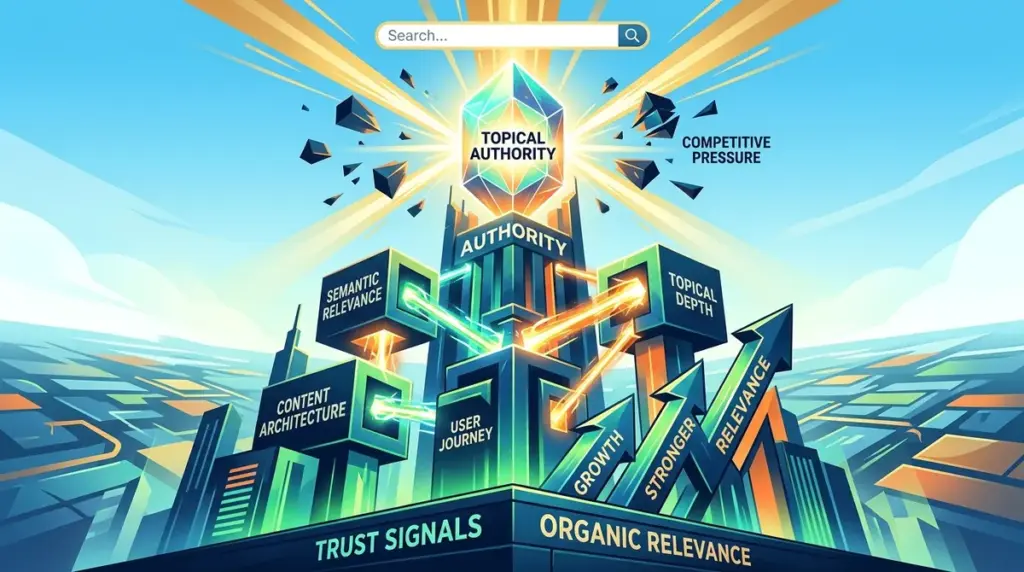
Topical authority is no longer a byproduct of high-volume publishing; it is the result of how effectively a site demonstrates expertise across a specific knowledge graph. While backlinks from external domains provide the raw power (PageRank), internal linking provides the context and structure that tell search engines what a website is actually about. Without a deliberate internal link strategy, even the most researched content remains isolated, forcing Google to guess the hierarchy and relationship between your pages. For agencies and site owners, mastering this connectivity is the difference between ranking for a single keyword and owning an entire vertical. Implementing these strategies can help achieve stronger topical authority through linking, solidifying your site's expertise in Google's eyes.
The Mechanics of Semantic Connectivity
Search engines use internal links to discover new content and to understand the semantic proximity of different pages. When you link from a high-authority "pillar" page to a detailed "cluster" post, you are signaling that these two pieces of information are part of the same thematic family. This creates a web of relevance that makes it easier for crawlers to index your site and for algorithms to verify your expertise.
Best for: Reducing crawl depth and ensuring that deep-level educational content inherits authority from top-level category pages.
Effective internal linking moves beyond simple navigation. It creates a "topical map" where every link serves as a vote of confidence for the destination page's relevance to a specific subtopic. If a site about "Commercial Real Estate" links frequently to pages about "Triple Net Leases," "Tenant Improvement Allowances," and "Zoning Laws," the search engine recognizes the site as a comprehensive resource for that niche, rather than just a collection of disparate articles.
Architecting the Pillar-Cluster Framework
The most reliable way to build topical authority is through the pillar-cluster model. This structure relies on a central hub—a comprehensive guide on a broad topic—that links out to several supporting articles. Each supporting article then links back to the hub. This circular flow of link equity ensures that if one page in the cluster gains a backlink or a surge in traffic, the entire group benefits from the increased visibility.
- Pillar Pages: Broad, high-level overviews that target high-volume, competitive terms.
- Cluster Content: Specific, long-tail articles that answer granular questions or solve niche problems.
- Contextual Links: In-body links that connect related cluster posts to one another, proving the depth of the site's knowledge.
By keeping the links mostly within the same topic silo, you prevent "authority leakage." Linking from a post about "SEO Audits" to a post about "Office Furniture" confuses the topical signal. Strict siloing ensures that the relevance remains concentrated where it matters most.
Warning: Avoid "orphan pages"—content with zero internal links. Even if an orphan page has great external backlinks, Google may struggle to understand its context within your site's specific hierarchy, often leading to lower rankings for its primary keywords.
Anchor Text as a Relevance Signal
Generic anchor text like "click here" or "read more" is a wasted opportunity for building topical authority. The anchor text is a descriptive label that tells the search engine exactly what the destination page is about. For internal links, you have total control over this text, allowing you to use descriptive, keyword-rich phrases that reinforce your topical focus.
However, precision is more important than repetition. Instead of using the exact same keyword for every link to a page, use semantic variations. If you are linking to a page about "Technical SEO," vary your anchors with "site speed optimization," "structured data implementation," and "indexability fixes." This breadth of language shows the search engine that the destination page is a comprehensive resource for the entire sub-niche, not just a single phrase.
Managing Link Density and Placement
The position of a link on the page affects its value. Links placed high in the body text (above the fold) generally carry more weight and have a higher click-through rate than links buried in the footer or sidebar. To maximize topical authority, prioritize links that occur naturally within the editorial flow. These "contextual links" are viewed as more helpful to the user and are weighted more heavily by modern search algorithms that prioritize helpful content over structural shortcuts.
Data-Driven Internal Link Auditing
Building authority requires ongoing maintenance. As a site grows, the original linking structure often breaks down. You might have new, high-quality posts that aren't being supported by older, high-authority pages. A quarterly audit is necessary to identify these gaps.
Best for: Identifying "power pages" that have high external authority but few outgoing internal links. These pages are your primary engines for distributing equity to newer content.
During an audit, look for pages that are ranking on page two or three of search results. Often, adding three to five internal links from relevant, high-traffic pages can provide the necessary "nudge" to move those pages into the top positions. This is a far more cost-effective strategy than acquiring new external backlinks, as it leverages the authority you already own.
Actionable Steps for Strengthening Topical Relevance
To turn internal linking into a competitive advantage, follow a systematic approach to content connectivity. Start by mapping your existing content into logical silos. If you find content that doesn't fit into a clear category, it may be diluting your topical authority and should either be updated to fit a silo or removed.
Next, implement a "link-up" strategy. Every time you publish a new piece of cluster content, find at least three existing pages on your site that are relevant and add a link to the new post. Simultaneously, ensure the new post links back to its parent pillar page. This immediate integration ensures the new content is indexed quickly and starts contributing to the site's overall authority score. Finally, use a site crawler to check for broken internal links and 301 redirects within your internal structure. A clean, direct path for both users and crawlers is essential for maintaining the integrity of your topical map.
Frequently Asked Questions
How many internal links should I have per 1,000 words?
There is no "magic number," but a good rule of thumb is 3 to 5 contextual links per 1,000 words. The priority should always be user utility; if a link helps the reader understand a complex sub-topic, it belongs there. Avoid "link stuffing," which can trigger spam filters and degrade the user experience.
Should I use 'nofollow' for internal links?
Almost never. Internal links should be "dofollow" to allow the flow of PageRank and to help search engines crawl your site. The only exception is for utility pages that have no search value, such as login screens or shopping carts, though 'noindex' is often a better solution for those cases.
Can internal linking help recover from a topical authority loss?
Yes. If a site has lost rankings due to a perceived lack of expertise, restructuring the internal links to more clearly define topic silos can help. By grouping related content and removing links to irrelevant sections, you clarify your site's purpose to the algorithm and can regain trust in your core niche.