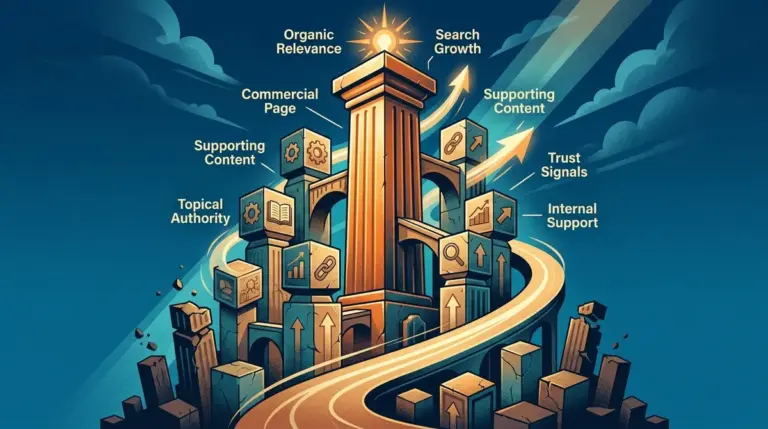


Most SEO campaigns fail not because they lack backlinks, but because the authority they do possess is trapped in the wrong places. A high-authority homepage or a viral blog post does nothing for your bottom line if that equity isn't flowing into your commercial service pages or high-intent product categories. To move the needle on competitive keywords, you must stop treating internal links as mere navigation and start treating them as a deliberate distribution system for PageRank and topical relevance.
The Mechanics of Equity Distribution
Authority is a finite resource. When a high-authority external site links to your content, that page becomes a reservoir of equity. If that reservoir has no outlets, the value stagnates. To pass authority effectively, you must understand the difference between site-wide architectural links and contextual body links. While header and footer links provide a baseline level of crawlability, Google’s weighted link model prioritizes links within the main content area. These contextual links carry significantly more weight because they imply a topical relationship between the source and the target.
Best for: Sites with high "Domain Authority" but low rankings for specific commercial keywords.
Strategic Internal Link Sculpting
Link sculpting is the practice of intentionally directing the flow of PageRank to your most important pages. This isn't about "nofollow" tags or hoarding link juice; it’s about reducing the path depth from your strongest pages to your "money" pages. A page that is one click away from the homepage will always carry more weight than one buried four levels deep.
Anchor Text Precision
Unlike external backlinks, where aggressive exact-match anchor text can trigger a Penguin-style penalty, internal links allow for much higher precision. You should use descriptive, keyword-rich anchor text that tells the crawler exactly what the destination page is about. Avoid generic phrases like "click here" or "read more." If you are trying to rank a page for "enterprise SEO services," that exact phrase should be your internal anchor text from relevant blog posts.
The Power of High-Value Page Placement
Identify your top 10 pages by external backlink count. These are your "power pages." Every one of these pages should link out to at least one commercial target. If a blog post about "SEO trends" has 50 referring domains, it should be funneling that authority directly to your service pages. This creates a direct pipeline of equity from earned media to your revenue-generating assets. This creates a direct pipeline of equity from earned media to your revenue-generating assets through effective supporting content reinforcing revenue-generating assets.
Pro Tip: Avoid the "First Link Priority" trap. Google typically only counts the first link it encounters on a page to a specific URL. If you have a link to your "Services" page in the navigation and another in the body copy, the navigation link (usually with generic anchor text) may take precedence. Ensure your most descriptive anchor text appears as early as possible in the HTML.
Leveraging Hub-and-Spoke Architecture
Topical authority is built through clusters. A hub-and-spoke model organizes content so that authority is consolidated within a specific subject matter. The "Hub" is your main pillar page (e.g., "The Ultimate Guide to Link Building"), and the "Spokes" are supporting articles (e.g., "How to Write Outreach Emails," "Broken Link Building Tactics").
- Bi-directional Linking: Every spoke must link back to the hub to reinforce its importance.
- Cross-Spoke Linking: Spokes should link to each other to demonstrate the depth of the topic.
- Equity Recycling: When a new spoke earns an external backlink, it immediately passes value back to the hub and across to the other spokes.
This structure prevents "orphaned pages"—content with no internal links—which Google often ignores regardless of their quality. By clustering content, you signal to search engines that your site is a definitive resource on a specific topic, which allows your "money pages" to rank with fewer external links than a disorganized competitor would need.
Eliminating Authority Leaks
Authority leaks occur when equity is directed toward pages that provide no SEO or business value. Common culprits include "Terms of Service" pages, login screens, or outdated blog posts that no longer serve a purpose. While you shouldn't "nofollow" internal links, you should be aggressive about pruning. If a page has no traffic, no backlinks, and no strategic value, delete it and 301 redirect the URL to a relevant high-value page. This reclaims any residual equity that was being wasted on a dead end.
Furthermore, fix your redirect chains. Every time a link passes through a redirect, there is a minor loss of equity. A 301 redirect is better than a 404, but a direct link to the final destination is always superior. Audit your site for 301s and update the source links to point directly to the live URL.
External Link Funneling Strategies
Most businesses point their guest post links and PR mentions to their homepage. This is a mistake. While it builds brand authority, it forces the equity to travel through multiple layers of navigation before reaching a product page. Instead, practice "Deep Linking." Direct your external acquisition efforts toward your hubs or high-value informational content. This content is easier to build links to than a sales page, but because of your internal linking structure, that authority flows immediately to your commercial targets.
Audit and Implement Your Authority Map
To start passing more authority today, perform a manual audit of your top-performing content. Use a crawler to identify pages with the highest "In-Link" count and compare that to your pages with the most external backlinks. If your most-linked pages aren't supporting your most-profitable pages, your architecture is broken. Map out your top five commercial keywords, identify the three blog posts most relevant to those keywords, and ensure they are linked with exact-match anchors. Repeat this process monthly to ensure that as you grow, your authority stays concentrated where it generates the most ROI.
Frequently Asked Questions
Does the number of links on a page dilute the authority passed?
Yes. PageRank is divided among all outgoing links on a page. If a page has 100 links, each link passes a smaller fraction of equity than if the page only had 10 links. Be selective with your internal links to ensure the most important targets receive a meaningful boost.
Should I use "nofollow" on internal links to save link juice?
No. This is an outdated tactic. Using "nofollow" on internal links essentially drops that equity into a void rather than redistributing it. If a page isn't worth passing authority to, consider if it should even be indexed or if it should be consolidated into another page.
How long does it take to see results from internal link changes?
Internal link changes are typically picked up as soon as Google recrawls the affected pages. For high-traffic sites, this can happen within days. However, the resulting ranking shift for the target page may take 2 to 4 weeks as the search engine re-evaluates the updated site architecture and equity flow.