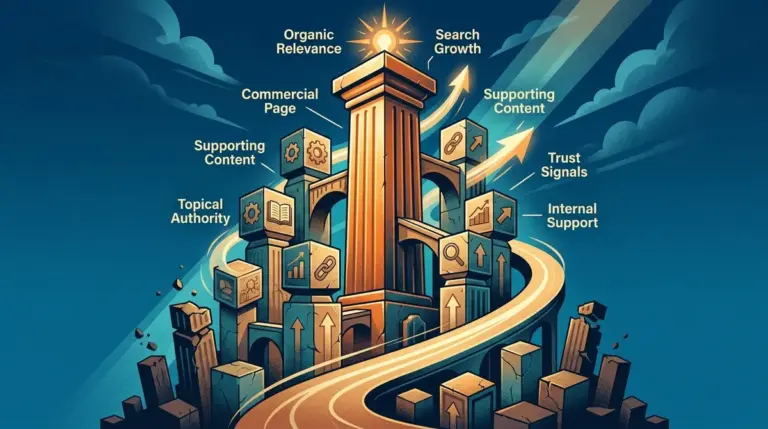


Internal linking is the primary mechanism for signaling topical hierarchy to search engines. While external backlinks remain a significant ranking factor, they are often outside a site owner's immediate control. Internal links, by contrast, represent a fully controllable lever for distributing PageRank, establishing semantic relationships between pages, and ensuring that Google’s crawlers prioritize your most valuable assets. Without a deliberate internal linking strategy, even high-quality content can remain "orphaned," disconnected from the site’s core authority and invisible to the algorithms that reward topical depth. Avoiding common internal linking mistakes that dilute authority is key to maximizing your site's potential.
Defining Topical Depth Through Link Architecture
Topical authority is not achieved simply by publishing a high volume of content; it is achieved by demonstrating the relationship between that content. Search engines use internal links to map the context of a website. When a pillar page on "Commercial Real Estate" links to a sub-topic on "Triple Net Leases," it reinforces the relevance of both. The pillar page gains depth, and the sub-topic gains inherited authority. Properly structuring content clusters ensures that search engines can effectively map your site's context and authority.
Strategic Priority: Use internal links to bridge the gap between informational "how-to" guides and commercial "service" pages. This transition helps search engines understand that your site is not just a repository of facts, but a functional authority in its niche. By linking from a high-traffic blog post to a high-conversion product page, you pass "link juice" (PageRank) to the pages that drive revenue, effectively grooming them for higher rankings in more competitive SERPs.
The Hub-and-Spoke Model for Authority
The hub-and-spoke model is the most efficient way to organize internal links for SEO. A central "hub" page targets a broad, high-volume keyword, while multiple "spoke" pages target long-tail, specific queries. Every spoke page must link back to the hub using descriptive anchor text. This creates a closed loop of relevance that makes it difficult for competitors to displace you. If one spoke page earns an external backlink, that equity flows through the internal link back to the hub, lifting the entire cluster.
Distributing PageRank and Link Equity
PageRank is a finite resource within a domain. A common mistake in site architecture is allowing equity to pool in low-value pages, such as "Contact Us" or "Privacy Policy," while critical money pages remain under-linked. To maximize organic performance, you must aggressively funnel equity from your top-performing pages—those with the most external backlinks—to the pages you want to rank next.
Best for: Sites with high-authority blogs but underperforming service or category pages. By identifying your "power pages" via a backlink audit, you can place manual editorial links within the body text to boost the visibility of stagnant commercial content.
Warning: Avoid excessive site-wide footer links. While they provide navigational utility, Google’s algorithms weight editorial links—those placed within the unique body content of a page—far more heavily than boilerplate links found in footers or sidebars. Over-reliance on footer links can lead to anchor text dilution and a lack of clear topical focus.
Strategic Anchor Text Selection
Anchor text is the descriptive label that tells Google what the destination page is about. Unlike external backlinks, where you have little control over the anchor text and must avoid over-optimization, internal links allow for precise, keyword-rich anchors. However, variety is still necessary to avoid looking like a bot-generated network. Use a mix of exact-match, partial-match, and long-tail anchors to build a natural but clear semantic map.
- Exact Match: Use for the primary keyword of the target page (e.g., "SEO Audit Services").
- Partial Match: Incorporate the keyword into a sentence (e.g., "how to perform a comprehensive SEO audit").
- Synonymous Match: Use related terms to broaden the semantic profile (e.g., "site health check").
- Navigational: Use for user flow (e.g., "Read the full guide").
Reducing Crawl Depth for Faster Indexing
Crawl depth refers to the number of clicks required to reach a page from the homepage. Pages buried more than three clicks deep are significantly less likely to be crawled frequently or indexed at all. For large publishers or e-commerce sites, this is a critical bottleneck. Internal linking solves this by creating "shortcuts" through related content sections and "Recommended Reading" modules.
By reducing crawl depth, you ensure that Google’s crawl budget is spent on your most important pages rather than wasting time on deep, paginated archives. A flat architecture—where internal links connect disparate silos—allows the crawler to discover new content faster, leading to quicker ranking updates after you refresh or publish new material.
User Experience and Conversion Paths
While the technical benefits of internal linking are clear, the commercial benefits are often overlooked. A well-placed internal link reduces bounce rates by giving the user a logical next step. If a visitor lands on a blog post about "Topical Authority," an internal link to a "Content Strategy Template" keeps them on the site longer. This increased dwell time and page-per-session count are secondary signals to search engines that your site provides a high-quality user experience.
More importantly, internal links guide users through the buyer’s journey. By linking from awareness-stage content (problem identification) to consideration-stage content (solution comparison), you move the prospect closer to a transaction. This is the difference between a site that just gets traffic and a site that generates revenue.
Implementing a High-Authority Internal Link Audit
To turn internal linking into a competitive advantage, you must treat it as a recurring maintenance task rather than a one-time setup. A quarterly audit of your link structure will reveal gaps where new content can support old pillars. Start by identifying "orphan pages"—those with zero incoming internal links—and integrate them into relevant clusters. Next, use a site crawler to identify broken internal links (404s) that are leaking PageRank. Finally, review your highest-traffic pages and ensure they are linking to your highest-conversion pages. This alignment of traffic and intent is the hallmark of a high-authority site.
Frequently Asked Questions
How many internal links should be on a single page?
There is no hard limit, but 3 to 5 editorial links per 1,000 words is a standard benchmark for readability and SEO. The goal is to provide value, not to overwhelm the reader or the crawler with a "wall of links" that dilutes the value of each individual link.
Should I use "nofollow" for internal links?
Generally, no. You want PageRank to flow freely through your site. The only exception is for pages you explicitly want to hide from search engines, such as login portals or filtered search results that create duplicate content. For everything else, use "dofollow" links.
Do internal links help with mobile SEO?
Yes. Mobile users rely heavily on clear navigation. Internal links within the content are often easier to interact with than complex hamburger menus. Since Google uses mobile-first indexing, a robust internal link structure that works on mobile is essential for maintaining your rankings.
Can I use the same anchor text for different pages?
Avoid this. Using the same anchor text for two different pages confuses search engines about which page is the definitive authority for that term. Each unique keyword or phrase should ideally point to one primary target page within your site architecture.