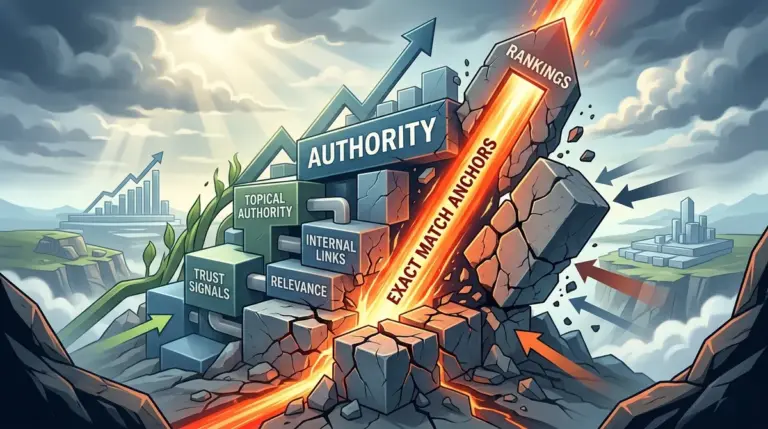

In high-stakes SEO, the raw volume of backlinks is a vanity metric that often leads to stagnation or manual penalties. The real currency of organic growth is link trust—the algorithmic confidence Google places in a backlink based on its proximity to verified, high-authority "seed sites." While Domain Rating (DR) or Domain Authority (DA) measure the strength of a site’s backlink profile, link trust measures the integrity of that profile. For publishers and agencies, understanding this distinction is the difference between building a sustainable digital asset and a site that collapses during the next core update. Ultimately, building a sustainable digital asset hinges on the principle that relevance matters more than raw metrics.
The Algorithmic Logic of TrustRank
Link trust is rooted in the TrustRank patent, an algorithm designed to combat web spam. The premise is simple: truly high-quality sites rarely link to low-quality or "spammy" sites. Google identifies a set of "seed sites"—entities like The New York Times, Wikipedia, or major university domains—and calculates the number of clicks (or "hops") it takes to get from those seeds to your website. The closer your site is to these seeds, the higher your trust score.
Strategic Impact: If your backlink profile consists primarily of guest posts from sites that are five or six hops away from a seed site, your "link juice" is diluted by the potential for spam. Conversely, a single link from a site directly connected to a seed site can carry more weight than fifty links from isolated, low-trust blogs.
Distinguishing Authority from Trust
It is a common mistake to conflate authority with trust. A site can have high authority (lots of incoming links) but low trust (those links come from questionable neighborhoods). Think of authority as the size of a site’s megaphone and trust as the credibility of the person holding it.
- Authority Signals: High total backlink count, diverse referring domains, and high-ranking keywords for competitive terms.
- Trust Signals: Physical address in the footer, clear editorial guidelines, a transparent "About Us" page, and a low ratio of outbound links to inbound links.
When vetting a potential link partner, look at their outbound link profile. If they are linking out to gambling, pharma, or essay writing services, their trust score is likely compromised, regardless of their DR. Linking to "bad neighborhoods" creates a proximity to spam that can rub off on your site.
Warning: Avoid "link farms" that boast high DR but have zero organic traffic. These sites have manipulated their authority metrics through circular linking schemes but possess no actual trust in the eyes of Google. A high-DR site with declining traffic is a major red flag for a trust deficit.
The Role of Topical Relevance in Establishing Trust
Trust is not just a global metric; it is increasingly topical. Google’s Knowledge Graph and Topic-Sensitive PageRank mean that a link from a trusted source within your niche is worth significantly more than a generic link from a high-trust site in an unrelated field. For example, a fintech startup gains more "topical trust" from a link on a respected accounting blog than from a high-authority lifestyle magazine.
Best for: Agencies looking to insulate clients against updates. Focus on "niche-adjacent" links where the audience overlap is logical. This reinforces your site’s position within a specific topical cluster, signaling to Google that you are a trusted authority within that vertical.
Internal Link Trust and Topical Support
Link trust isn't exclusively an external factor. How you distribute trust within your own architecture determines which pages rank. A "money page" buried deep in your site with no internal links from your high-traffic, trusted blog posts will struggle to rank, even if it has external backlinks.
To maximize internal trust flow, use a hub-and-spoke model. Your "hub" (a comprehensive guide) should receive the bulk of external links, which then distribute that trust to "spoke" pages (specific product or service pages) via descriptive, keyword-rich anchor text. This creates a closed loop of relevance and trust that tells crawlers which pages are the most important.
Quantifiable Metrics for Vetting Link Trust
Since Google does not publish a "Trust Score," SEO professionals must use proxy metrics to evaluate the integrity of a link. Beyond the standard third-party scores, consider these concrete data points:
1. Traffic-to-Link Ratio: A site with 50,000 backlinks but only 500 monthly organic visitors is likely a link farm or a site that has been penalized. A healthy, trusted site should have a logical correlation between its link profile and its ability to rank for keywords.
2. Outbound Link Integrity: Use an SEO tool to audit the site's external links. If more than 20% of their outbound links are to non-authoritative or commercial "best [product]" pages without proper disclosure, the site is likely selling links, which degrades its trust over time.
3. Brand Search Volume: Trusted sites have "navigational intent." If people are searching for the site by name (e.g., "Insane Authority SEO tips"), Google views that site as a legitimate entity rather than a disposable content play.
Building a Trust-First Link Strategy
To move away from shallow metric chasing, your link-building strategy must prioritize the "neighborhood" over the "number." This involves a shift in how you allocate your budget and time.
Instead of purchasing ten $100 guest posts on generic sites, invest that $1,000 into a single piece of original research or a data-driven infographic that can earn a link from a tier-one industry publication. These "earned" links are the ultimate signals of trust because they require editorial oversight—a human gatekeeper has essentially vouched for your content.
Actionable Checklist for Link Vetting:
- Does the site have a visible team or real human authors?
- Is the site's organic traffic trend stable or growing over a 12-month period?
- Does the site rank for its own brand name?
- Are the advertisements on the site intrusive or deceptive?
- Is the content written for humans, or is it a keyword-stuffed AI output?
Future-Proofing Your Organic Presence
As Google’s AI-driven algorithms (like SGE and Gemini) become more adept at identifying the intent and source of information, link trust will only increase in importance. The "helpful content" updates have shown that Google is aggressively devaluing content that exists solely to capture search traffic without providing genuine value or expertise. By focusing on link trust, you are not just optimizing for a search engine; you are aligning your site with the signals of credibility that both users and algorithms demand.
Frequently Asked Questions
Does a 'nofollow' link provide trust?
While nofollow links do not pass direct PageRank (authority), they can provide trust signals. A nofollow link from a massive seed site like Wikipedia or a major news outlet suggests to Google that your site is being mentioned in high-trust environments, which can indirectly benefit your overall credibility.
Can I lose link trust?
Yes. Link trust is lost if you begin participating in manipulative link schemes, if your site is hacked and hosts malicious content, or if you link out to "bad neighborhoods." Trust is much harder to regain than it is to build initially.
Is link velocity a trust signal?
Link velocity—the rate at which you acquire links—is a secondary signal. A sudden spike in links from low-trust sites is a footprint for manipulation. However, a spike in links from high-trust sites (such as a viral news story) is seen as a natural, positive signal. The quality of the sources matters more than the speed of acquisition.