

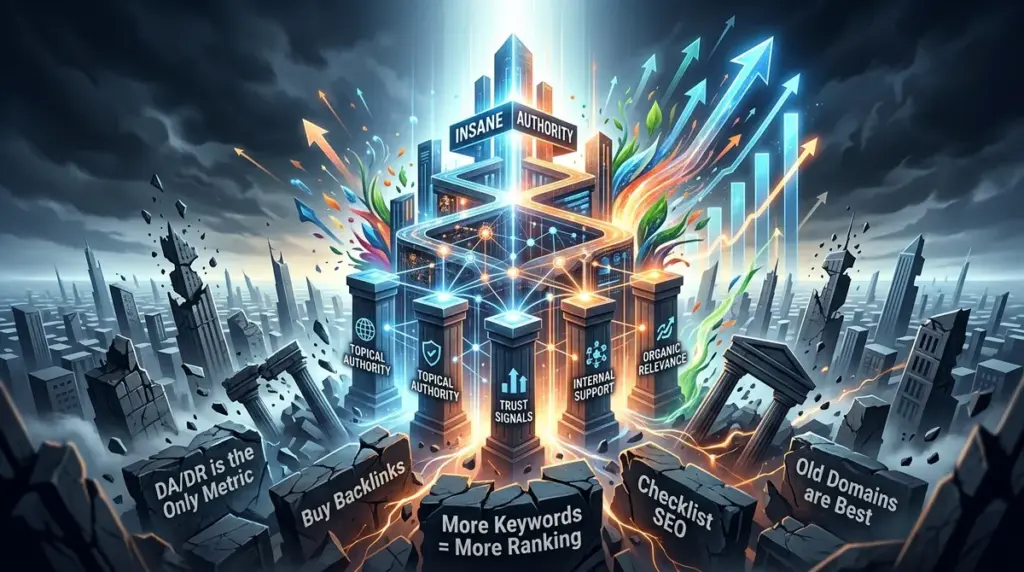
SEO strategy often founders on the rocks of vanity metrics. For years, the industry has leaned on third-party scores as a shorthand for "authority," leading to a culture of metric-chasing that frequently ignores how modern search engines actually evaluate a domain. If you are making investment decisions based solely on a dashboard number, you are likely misallocating your budget and ignoring the structural flaws that prevent your content from ranking.
Real authority is not a single number; it is a composite of topical relevance, historical trust, and the demonstrated ability to satisfy specific user intents. To build a resilient search presence, you must dismantle the common misconceptions that lead to "hollow" authority—sites that look strong on paper but fail to convert impressions into sustainable revenue.
Third-Party Scores Are Not Google Ranking Factors
The most persistent myth in the industry is that metrics like Domain Authority (DA) or Domain Rating (DR) are used by Google's algorithm. They are not. These are proprietary calculations developed by software companies to simulate how Google might view a site's backlink profile. While they can be useful for high-level competitive benchmarking, they are predictive, not causative.
Best for: Initial prospecting and identifying broad trends in a niche, rather than measuring the success of an individual campaign.
Google evaluates authority through a complex web of signals including PageRank (which still exists in an evolved form), the "Helpful Content" system, and entity-based relevance. A site can have a DR of 80 and still lose rankings to a DR 30 site that possesses superior topical depth and better alignment with E-E-A-T (Experience, Expertise, Authoritativeness, and Trustworthiness) guidelines. Relying on these scores as a primary KPI leads to "metric manipulation"—buying links from sites that have inflated their own scores through spammy redirects rather than genuine editorial value.
Warning: Chasing a specific DR number often leads to "metric manipulation"—buying cheap, high-DR redirects or guest posts on bloated PBNs that provide zero referral traffic and high footprint risk. If a site has high authority but zero organic traffic, the authority is likely artificial.
The Volume Delusion in Link Building
There is a prevailing belief that the site with the most links wins. In the early 2010s, this was largely true. Today, it is a recipe for a manual action or a significant algorithmic devaluation. The "link graph" is now filtered by relevance and neighborhood trust. A single link from a high-traffic, niche-relevant publication is worth more than 50 links from generic "write for us" sites that cover everything from crypto to gardening.
Assessing Link Neighborhoods
When Google crawls a site, it looks at the neighborhood. If your site is linked to by a network of sites that only link to other low-quality sites, your "authority" is tainted by association. High-quality authority is built by earning mentions from sites that Google already trusts to be authorities in your specific vertical. Relevance acts as a multiplier for link equity; a link from a specialized medical journal to a healthcare site carries significantly more weight than a link from a general news aggregator.
Topical Authority vs. Broad Domain Strength
Many publishers believe that once they achieve a certain "authority level," they can rank for any keyword. This is the "Generalist Trap." Google’s move toward entity-based search means it evaluates your authority on a per-topic basis. This is known as Topical Authority.
If your site is an established authority on "enterprise cloud security," you will find it relatively easy to rank for new keywords in that cluster. However, if you suddenly try to rank for "best coffee makers," your high domain strength will not save you. You lack the semantic depth and supporting content to prove you are a trusted source for that specific intent. Building authority requires a "hub and spoke" approach:
- Pillar Pages: High-level overviews that target broad, high-volume terms.
- Supportive Content: Granular articles that answer long-tail questions and link back to the pillar.
- Internal Linking: Strategic use of descriptive anchor text to distribute "link juice" from high-performing pages to newer content.
- Semantic Coverage: Ensuring you have covered the "entities" and sub-topics that Google expects to see in a comprehensive guide.
Neglecting the Internal Architecture of Trust
Website authority is often discussed as something that happens *to* a site from the outside, but internal architecture is what dictates how that authority is utilized. A site with a "flat" structure—where every page is three or four clicks away from the homepage—struggles to pass equity effectively. Understanding what website authority means is key to grasping how internal architecture dictates its effective utilization.
Internal linking is the circulatory system of your website’s authority. If you earn a high-tier backlink to a specific blog post, that equity stays trapped in that post unless you strategically link to your commercial "money" pages. Many sites fail to rank not because they lack backlinks, but because their internal link structure is so fragmented that Google’s crawlers cannot determine which pages are the most important. This fragmented structure directly affects how authority impacts rankings, preventing Google from identifying your most vital content.
The Role of "Trust Signals" Beyond Links
Authority is also built through non-link signals that indicate a legitimate business entity. These include:
• Clear, verifiable author bios with links to social profiles or professional credentials.
• Robust "About Us" and "Contact" pages that provide physical addresses and real-world identifiers.
• A consistent history of content updates that show the site is actively maintained.
• Positive brand mentions across the web that don't necessarily include a hyperlink (unlinked brand mentions).
The False Safety of High-DR Backlinks
Buying links based on DR alone is a common mistake for agencies looking to show quick "progress" to clients. However, many high-DR sites are "zombie sites"—domains that were once authoritative, expired, and were bought by SEOs to host guest posts. These sites often have declining traffic and are one algorithm update away from being deindexed.
Practical Check: Before acquiring a link, check the site’s organic traffic trend in a tool like Semrush or Ahrefs. If the DR is 70 but the traffic has dropped from 100k to 5k over the last year, that site is toxic. The "authority" is a ghost of its former self, and a link from it could actively harm your site's reputation.
Operationalizing Authority for Long-Term Growth
To move beyond myths, your SEO strategy must pivot from "collecting links" to "building a brand." This means focusing on content that earns links naturally because it provides unique data, a contrarian viewpoint, or a superior utility. Stop viewing authority as a score to be increased and start viewing it as a moat to be built.
Prioritize the following actions to solidify your real-world authority:
1. Audit your backlink profile for "metric-inflated" sites and stop pursuing them.
2. Map out your topical clusters to identify gaps in your expertise.
3. Optimize your internal linking to ensure equity flows to your highest-converting pages.
4. Enhance your E-E-A-T by bringing in subject matter experts to review or author your content.
Frequently Asked Questions
Does a high DA/DR guarantee higher rankings?
No. These metrics are third-party estimates. A site with a lower score but higher topical relevance and better user engagement will frequently outrank a high-score site that lacks specific depth.
Can I build authority without backlinks?
While difficult, it is possible to build "topical authority" through sheer content volume and internal linking. However, for competitive terms, external validation (links) remains a primary signal that Google uses to break ties between two high-quality pieces of content.
How long does it take to see the effects of new authority?
Building genuine authority is a slow process. While a single high-quality link can show results in weeks, establishing topical authority usually takes 3 to 6 months of consistent content publishing and strategic internal linking.
Are unlinked brand mentions valuable for authority?
Yes. Google’s patents and search quality evaluator guidelines suggest that the engine recognizes brand mentions as a signal of popularity and trust, even without a direct hyperlink. This contributes to your overall "entity" strength.