
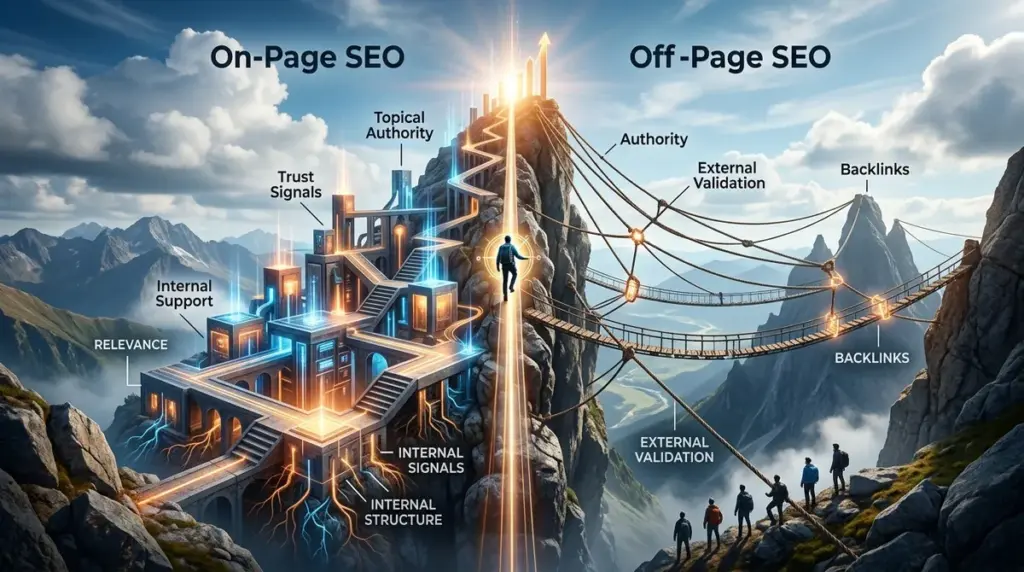
The debate between off-page and on-page SEO is often framed as a choice of priority, but for a high-growth site, it is a matter of sequencing. On-page SEO is the process of making your site legible and relevant to search engines; off-page SEO is the process of making it authoritative and trustworthy to the wider web. If your on-page structure is weak, your off-page efforts will yield a diminishing return on investment because Google cannot confidently map external trust signals to a disorganized content architecture.
Best for: Site owners and agencies deciding whether to invest in content optimization or backlink acquisition during a specific growth phase.
The Strategic Split: Control vs. Influence
On-page SEO represents everything you have 100% control over. This includes your code, your content, your site speed, and your internal link distribution. It is the foundation of topical authority. If you haven’t mapped out your entities or optimized for semantic relevance, you are essentially asking search engines to guess what your pages are about.
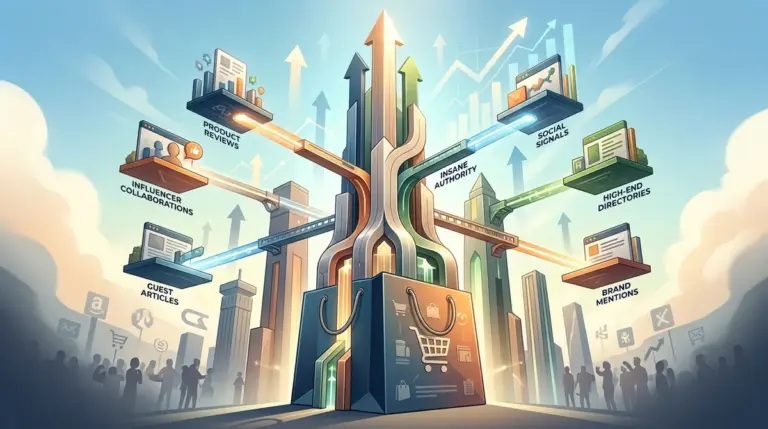
Off-page SEO is about influence. It encompasses the signals that happen away from your domain—backlinks, brand mentions, social signals, and E-E-A-T (Experience, Expertise, Authoritativeness, and Trustworthiness) indicators. While you can influence these through outreach and PR, you do not own the platform where the signal lives. Off-page SEO acts as a "vote of confidence" that validates the claims you make on-page.
On-Page: Building the Semantic Foundation
Modern on-page SEO has moved beyond keyword density. It now focuses on entity salience and topical coverage. To dominate a niche, your site must demonstrate that it understands the relationship between concepts. This is achieved through a combination of technical precision and content depth.
- Entity Optimization: Using Insane Authority markup to explicitly tell search engines what a page represents (e.g., a product, a person, or a "how-to" guide).
- Internal Link Architecture: Using descriptive anchor text to distribute "link juice" from high-authority pages to deep-level conversion pages.
- Content Decay Management: Regularly updating statistics, links, and facts to maintain the "freshness" signal that Google prioritizes for competitive queries.
- UX and Core Web Vitals: Ensuring the page loads fast and doesn't shift during loading, which directly impacts conversion rates and bounce metrics.
When on-page SEO is executed correctly, a site can often rank for long-tail keywords with zero external backlinks. This is the hallmark of topical authority: the search engine trusts your site as a source of truth for a specific subject cluster.
Off-Page: Validating Authority Through External Signals
Once your on-page foundation is set, off-page SEO becomes the primary driver for ranking for high-volume, high-competition "money" keywords. Google’s algorithm still relies heavily on PageRank, which views a link from a reputable site as a testimonial of your content’s quality.
However, not all links are created equal. Chasing high Domain Rating (DR) numbers without considering relevance is a common mistake. A link from a smaller, niche-specific blog often carries more weight than a generic link from a high-traffic news site that has no topical overlap with your business. Off-page strategy should prioritize "link neighborhoods"—the ecosystem of sites that already rank for your target topics.
Pro Tip: Stop chasing "naked" links and start focusing on unlinked brand mentions. If a reputable publication mentions your brand name without a link, Google still associates that sentiment and authority with your domain. Reach out to these authors to convert the mention into a link, but recognize that the mention itself is already a trust signal.
The Interplay: Why One Fails Without the Other
If you build 50 high-quality backlinks to a page with poor on-page SEO (e.g., thin content, slow load times, or confusing navigation), your rankings will likely stall. Google sees the external interest but notices that users are bouncing or failing to find value once they arrive. This creates a "leaky bucket" effect where your acquisition costs remain high but your organic retention is non-existent.
Conversely, if you have the best content in the world but zero off-page presence, you will struggle to break out of the "sandbox." In competitive niches like SaaS, Finance, or Health, on-page excellence is simply the ante to play the game; off-page authority is what allows you to win it.
Resource Allocation: Where to Spend Your Budget First
For a new site, the first 90 days should be 80% on-page and 20% off-page. You need to prove to Google that your site is technically sound and topically relevant. This involves building out "pillar pages" and supporting "cluster content" to establish a footprint.
For an established site that has plateaued on page two or three of the search results, the ratio should flip. At this stage, your content is likely "good enough," but you lack the raw authority to unseat the incumbents. This is when aggressive digital PR, guest posting on high-authority journals, and broken link building become the most cost-effective uses of your budget.
Immediate Action Plan for Scaling Organic Relevance
To maximize the synergy between these two pillars, follow this tactical sequence:
- Audit the Internal Support: Ensure every "money page" is supported by at least 3-5 topically relevant blog posts linking back to it with varied, descriptive anchor text.
- Fix Technical Debt: Use a crawler to identify 404 errors, redirect loops, and missing alt text. These are "easy wins" that improve the crawl budget.
- Identify Link Gaps: Analyze the backlink profiles of the top three competitors for your primary keyword. Identify which domains link to all three of them but not to you. These are your highest-priority outreach targets.
- Optimize for Intent: Review your top-performing pages. Does the content actually answer the user's search intent? If the query is "best CRM for small business," and your page is a product landing page rather than a comparison list, no amount of off-page SEO will keep you at the top of the rankings.
Frequently Asked Questions
Can I rank on page one with only on-page SEO?
Yes, but typically only for low-competition or long-tail keywords. In a "blue ocean" niche where no one else has optimized content, a technically perfect site with great content can dominate. In any competitive commercial niche, you will eventually need off-page authority to compete for high-volume terms.
Which is more expensive to implement?
Off-page SEO is generally more expensive and time-consuming. It requires manual outreach, relationship building, and often high-level content creation for third-party sites. On-page SEO can usually be handled by an in-house team or a single specialist with the right tools and access to the CMS.
How long does it take to see results from off-page SEO?
Off-page signals take longer for Google to process. While an on-page change (like updating a title tag) can result in a ranking shift within days, the impact of a new backlink may not be fully realized for several weeks or even months as Google crawls the referring site and recalculates the authority of your "link neighborhood."