

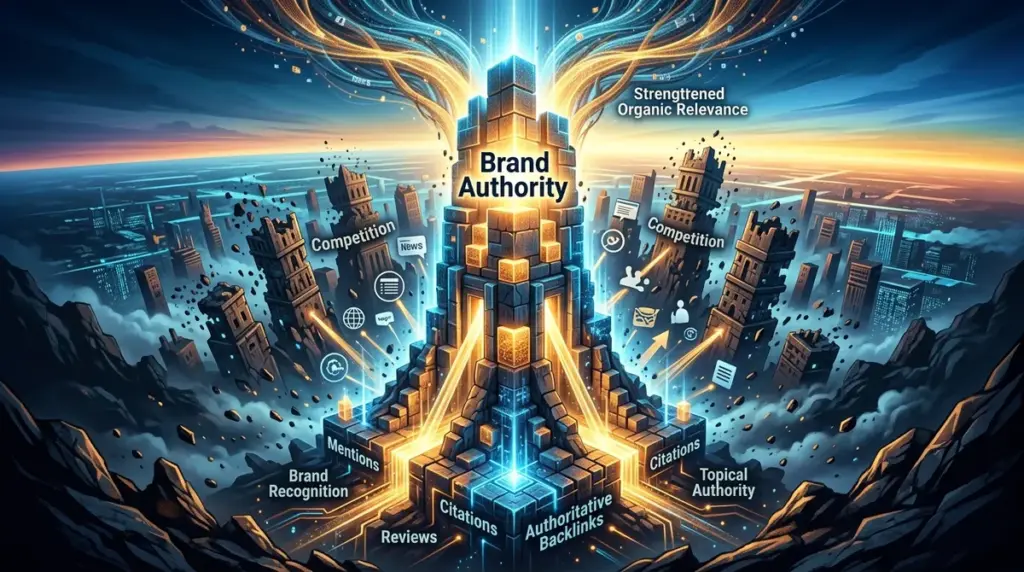
Backlink acquisition in isolation is a failing strategy. While the SEO industry spent a decade chasing Domain Rating (DR) and guest post volume, Google shifted its focus toward entity-based indexing and E-E-A-T (Experience, Expertise, Authoritativeness, and Trustworthiness). A site that possesses a massive backlink profile but zero brand recognition is a statistical anomaly that triggers manual reviews and algorithmic devaluations. To survive current volatility, off-page SEO must transition from link building to brand building. Transitioning from link building to brand building means understanding the most key off-page SEO signals that Google values today.
Brand signals are the non-link data points that inform Google’s Knowledge Graph about your site’s legitimacy. When a brand is mentioned across reputable news outlets, discussed on social platforms, and searched for by name, it creates a "trust moats" that protects the site from core updates. This is not about vanity; it is about providing the algorithm with the necessary context to categorize your site as a topical authority rather than a generic content farm.
The Mechanics of Entity-Based Search
Google no longer views websites as mere collections of keywords and hyperlinks. Through its Knowledge Graph, the algorithm attempts to understand "entities"—uniquely identifiable objects or concepts. Your brand is an entity. If Google cannot connect your domain to a real-world entity with a verifiable footprint, your links carry significantly less weight.
Entity Validation: This occurs when your brand name appears in close proximity to your target keywords across the web. If "Insane Authority" is frequently mentioned alongside "topical authority" and "SEO strategy" on third-party sites, Google’s NLP (Natural Language Processing) engines build a semantic connection. Eventually, the brand itself becomes synonymous with the topic, allowing the site to rank for high-competition terms with fewer direct backlinks than a "brandless" competitor.
Branded Search Volume as a Ranking Multiplier
One of the most potent off-page signals is the ratio of branded search volume to total organic traffic. When users search for your brand name directly or combine it with a keyword (e.g., "Insane Authority link building"), it sends an unambiguous signal to Google that your site is a destination, not just a search result. This user behavior validates your authority more effectively than a standard backlink because it cannot be easily faked at scale.
Best for: Sites in YMYL (Your Money, Your Life) niches where trust signals are the primary differentiator between Page 1 and Page 10.
High branded search volume suggests a loyal audience and a high level of trust. To trigger this, off-page efforts should include:
- Podcast appearances that drive listeners to search for the brand.
- Strategic Digital PR that places the brand name in front of relevant audiences.
- Social media campaigns that focus on brand recall rather than just outbound clicks.
Warning: Avoid "ghost" brands. If your site has 500 referring domains but zero monthly searches for its brand name, you are a prime target for a "Helpful Content" devaluation. Google views this discrepancy as a sign of artificial link manipulation.
The Role of Unlinked Brand Mentions
For years, SEOs viewed unlinked mentions as missed opportunities. However, Google’s patents, specifically those regarding "implicit links," suggest that the algorithm recognizes brand mentions even without a <a> tag. These mentions serve as citations that verify the brand’s presence within a specific industry.
When a major industry publication mentions your research or quotes your founder without linking back, it still contributes to your topical authority. It places your entity within the same neighborhood as other established authorities. This "co-citation" is a critical component of off-page SEO that many agencies overlook in favor of chasing do-follow links on mediocre sites.
Digital PR vs. Traditional Link Building
Traditional link building often involves reaching out to mid-tier bloggers for guest posts. While this can build "link juice," it rarely builds brand signals. Digital PR, conversely, focuses on earning placements in top-tier media outlets like Forbes, Bloomberg, or niche-specific giants. These placements provide:
- Trust by Association: Being mentioned on a site with high editorial standards transfers a degree of that trust to your entity.
- Referral Traffic: Real humans clicking through to your site, which is a behavioral signal Google tracks via Chrome data and Google Analytics.
- Sustainable Authority: A single mention in a high-authority news piece is worth more than 50 links from "write for us" sites that exist only to sell links.
Social Proof and Engagement Metrics
While social media links are generally "no-follow" and do not pass PageRank, the activity surrounding a brand on social platforms is a vital off-page signal. A brand that is "alive" has active profiles, consistent engagement, and a community. This activity acts as a verification layer. If a site claims to be an authority in the "SaaS marketing" space but has no presence on LinkedIn or Twitter where that community lives, the claim is less credible to search engines.
Strategic Implementation: Focus on platforms where your target audience is most active. For B2B, a high-engagement LinkedIn presence with employees linked to the brand page creates a network of entity associations that reinforces the main domain’s authority.
Operationalizing Brand Signals for Long-Term Growth
To move beyond shallow metric chasing, your off-page strategy must prioritize entity clarity. Start by auditing your current footprint. Is your brand name consistent across all platforms? Are your founders or key authors recognized as experts in their own right? Use tools to monitor unlinked mentions and reach out to turn them into links where possible, but value the mention itself as a trust signal.
Shift your budget from low-quality link packages to high-impact Digital PR and brand-building activities. The goal is to create a digital footprint that makes it impossible for Google to ignore your site’s relevance to your target topics. When your brand becomes a household name in your niche, the links will follow naturally, and your rankings will become far more resilient to algorithmic shifts.
Frequently Asked Questions
Do unlinked brand mentions help with SEO?
Yes. Google uses Natural Language Processing to identify brand names and associate them with specific topics and keywords. These "implicit links" help build the entity’s authority even without a direct hyperlink, though a link is still preferable for direct traffic and PageRank transfer.
How can I increase my branded search volume?
Focus on top-of-funnel awareness through guest appearances on podcasts, speaking at industry events, and running targeted social media ads. The goal is to make your brand the "go-to" name for a specific solution, prompting users to search for you by name rather than just by a generic keyword.
What is the most important brand signal for a new site?
Consistency and association. Ensure your NAP (Name, Address, Phone Number) and brand description are identical across all social profiles and directories. Simultaneously, aim for mentions on established sites within your niche to "anchor" your new entity to the correct topical cluster.