
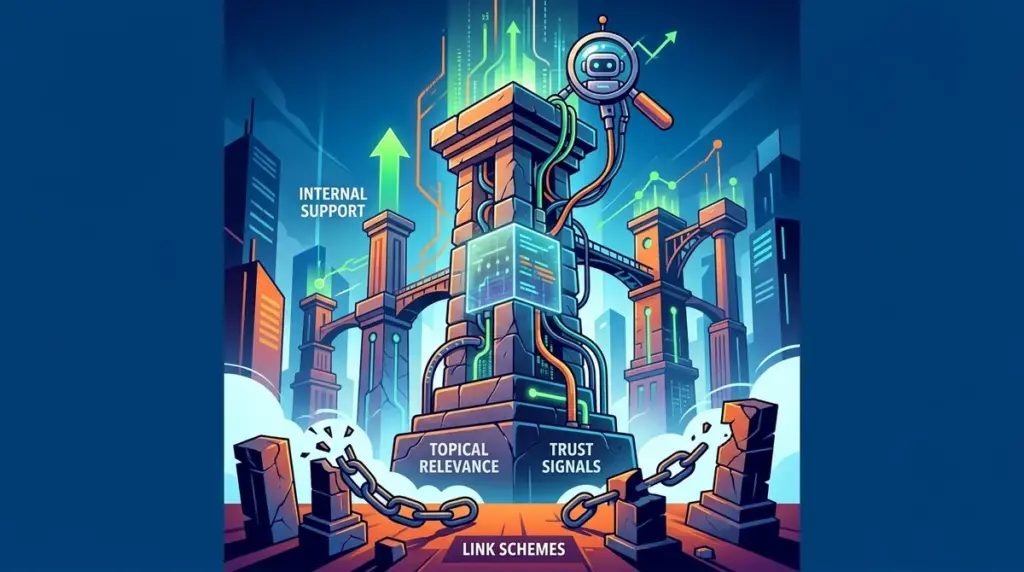
Link building is no longer a volume game; it is a verification of topical expertise. In the current search landscape, search engines have moved beyond simple citation counting to a sophisticated model of semantic validation. A single link from a topically relevant, high-traffic domain now outweighs hundreds of low-quality placements that lack contextual alignment. For SEO professionals and site owners, understanding how search engines judge link quality is the difference between building a resilient organic moat and wasting a budget on links that will eventually be ignored or penalized by core algorithm updates. Understanding the nuances of how search engines judge link quality is paramount for effective SEO strategies.
The Semantic Bridge: Why Topical Alignment Dictates Weight
Search engines use a concept known as Topic-Sensitive PageRank to determine the value of a backlink. This means a link is not just a "vote"; it is a bridge between two nodes of information. If a website specializing in enterprise cybersecurity links to a page about cloud storage solutions, the semantic bridge is strong. The search engine perceives the referring site as an authority in a related field, thereby passing significant "trust" to the target page.
Conversely, if that same cybersecurity site links to a recipe for vegan lasagna, the link carries almost no weight. The search engine recognizes the lack of topical proximity. Best for: Long-term ranking stability and avoiding "unnatural link" flags during core updates.
Assessing the Source Page’s Keyword Footprint
To judge quality, you must look at what the referring page actually ranks for. A page that ranks in the top three positions for its primary keywords is a "trusted node." When it links to you, it transfers a portion of that established trust. If the source page itself has no organic visibility and ranks for zero relevant terms, it is a signal that the search engine does not value that page's content, and by extension, will not value the links coming from it.
The Reasonable Surfer Model: Placement and Clickability
Google’s "Reasonable Surfer" patent changed the way link equity is distributed. Search engines do not treat every link on a page equally. Instead, they estimate the probability of a user actually clicking the link. This probability is determined by several concrete factors:
- Font Size and Color: Links that are styled to blend into the background or are significantly smaller than the surrounding text are devalued.
- Position on the Page: Links in the main body of the content (the "editorial" section) carry the most weight. Links in the footer, sidebar, or navigation menus are often categorized as boilerplate and carry minimal equity.
- Above the Fold: A link located in the first few paragraphs is generally viewed as more important than one buried at the bottom of a 2,000-word article.
If a link is placed in a way that suggests it was designed to be seen and used by a human, the search engine rewards it. If it looks hidden or automated, it is treated as noise.
Pro Tip: Before securing a link, use a tool to check the "Outbound Link to Inbound Link" ratio of the referring domain. If a site has 500 referring domains but links out to 5,000 external sites, it is likely a link farm. These sites exist solely to sell links, and search engines eventually neutralize their impact by devaluing the entire domain's outbound equity.
Evaluating the Source Site’s Outbound Link Hygiene
Search engines judge a site by the company it keeps. A high-quality referring domain is selective about who it links to. If you find a potential link prospect that links out to gambling, pharma, or essay writing services alongside legitimate businesses, that domain is "polluted." This is often referred to as a "bad neighborhood." Linking from a site with poor outbound link hygiene can actually harm your site’s trust signals, as it suggests you are participating in a low-tier link scheme.
Traffic as a Proxy for Legitimacy
One of the most reliable indicators of link quality is the organic traffic of the referring site. While metrics like Domain Rating (DR) or Domain Authority (DA) are useful third-party proxies, they are easily manipulated. Organic traffic is much harder to fake. A site that receives consistent, growing traffic from search engines is a site that the algorithm currently trusts.
Best for: Validating guest post opportunities and niche edits. If the site has seen a massive traffic drop in the last six months, it may have been hit by a "Helpful Content" or "Spam" update. A link from a penalized site is a liability, not an asset.
Anchor Text Distribution and Natural Language Processing
Search engines use anchor text to understand the context of the destination page. However, they are also highly sensitive to over-optimization. In a natural ecosystem, most links use "branded" anchors (the site name) or "naked URLs." If 50% of your backlinks use exact-match keywords (e.g., "best affordable running shoes"), it triggers a manual or algorithmic review for link manipulation.
Modern NLP (Natural Language Processing) allows search engines to understand the text *surrounding* the link. Even if the anchor text is "click here," the engine looks at the surrounding sentence to determine the topic. High-quality links are those where the surrounding text provides a logical, helpful reason for the link to exist.
Executing a Quality-First Link Strategy
To build a profile that search engines reward, you must prioritize integrity over metrics. Stop chasing the highest DR possible and start chasing the highest topical relevance. A link from a DR40 site that is a leader in your specific niche is worth more than a link from a DR80 general news site that covers every topic under the sun. Focus on "Seed Sites"—the authoritative hubs in your industry that search engines use as the starting point for crawling and calculating authority. When you earn a link from a site that is only one or two hops away from a Seed Site, your organic relevance grows exponentially.
Frequently Asked Questions
Does the age of a link matter?
Yes. Older links are often viewed as more "stable" and trustworthy. However, if a link is on a page that is no longer being updated or has lost its own traffic, its value may decay over time. Fresh links from growing sites often provide a more immediate ranking boost.
Are nofollow links completely useless?
No. While they do not pass direct PageRank, they provide "hint" signals to search engines. More importantly, nofollow links from high-traffic sites drive referral traffic and contribute to a natural-looking backlink profile. A profile with 100% dofollow links is a red flag for manipulation.
How many links from one domain do I need?
The first link from a unique referring domain provides the most equity. Subsequent links from the same domain have diminishing returns. It is generally more effective to get one link from ten different authoritative sites than ten links from a single site.
Is anchor text still a ranking factor?
Yes, but it is now a secondary signal to the surrounding content. Search engines prioritize the "contextual relevance" of the paragraph where the link sits. Over-optimizing anchor text is one of the fastest ways to trigger a ranking suppression.