

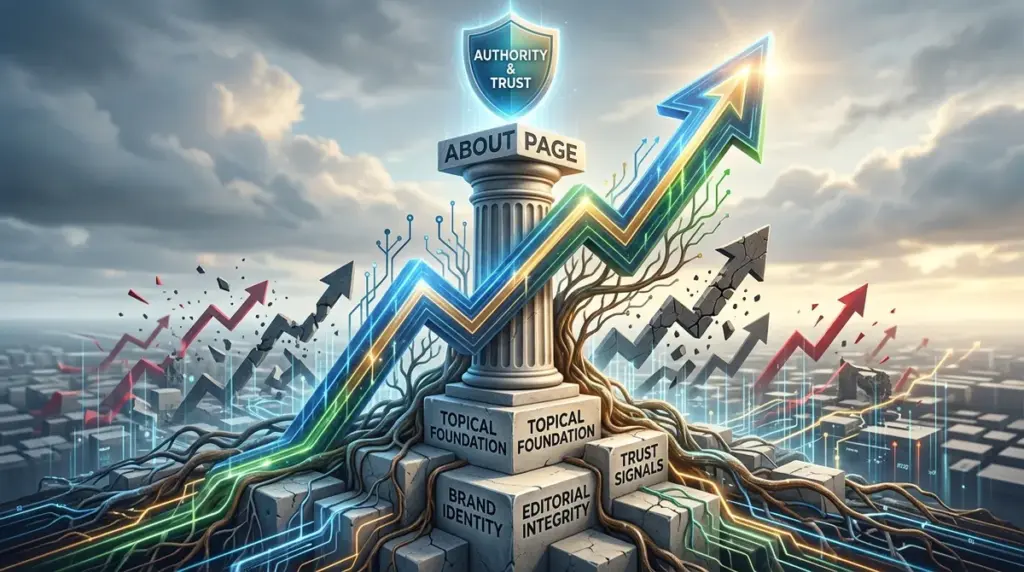
Most site owners treat the About page as a secondary obligation—a place for a generic mission statement and a stock photo of a handshake. This is a strategic error. In an era where search engines prioritize E-E-A-T (Experience, Expertise, Authoritativeness, and Trustworthiness), the About page functions as the primary document for verifying the "responsible party" behind a domain. For high-stakes niches, particularly Your Money Your Life (YMYL) sectors, a weak About page is a direct signal of low quality that can suppress rankings across the entire site. Credibility is not a subjective "vibe"; it is a verifiable set of data points that search engines and users use to determine if your content is safe to consume and recommend. This is because a lack of trust signals can directly affect how search engines perceive your site's authority and how website credibility impacts rankings.
The Mechanical Role of Identity in Search Quality Evaluation
Google’s Search Quality Rater Guidelines (SQRG) explicitly instruct human raters to find out who is responsible for a website and who created the content on the page. If this information is difficult to find or appears intentionally obscured, the site is often flagged as low quality. From a technical SEO perspective, the About page serves as the "Entity Home." It is the central node where you define your brand’s relationship to its authors, its physical location, and its specialized knowledge.
When a search engine crawls an About page, it looks for structured data and natural language that confirms the site belongs to a legitimate organization or a recognized expert. By linking from your About page to external, authoritative sources—such as professional associations, press mentions, or verified social profiles—you create a closed loop of verification. This process, known as entity reconciliation, helps search engines move beyond keywords and understand your site as a trustworthy authority within a specific topical map.
Experience and Expertise as Tangible Assets
The "Experience" component of E-E-A-T requires proof that the content creators have first-hand involvement with the topic. An About page should not just list titles; it should detail specific projects, years in the industry, and unique perspectives. For a medical site, this means listing credentials and board certifications. For a product review site, it means showing the testing lab or the specific methodology used to evaluate gear. Without these concrete details, your claims of expertise are merely unverified marketing copy.
Structural Authority and Internal Link Distribution
Beyond trust signals, the About page plays a vital role in information architecture. It is typically one of the most linked-to pages on a site, often residing in the global header or footer. This means it holds significant internal link equity. Smart SEOs leverage this by using the About page to link out to core "pillar" pages or topical hubs. This passes authority from the brand's identity directly to its most important commercial or educational content.
Strategic Tip: Use the About page to define your editorial mission and then link to the categories that represent your deepest topical authority. This reinforces to crawlers that your brand identity is inextricably linked to those specific subjects.
The Anatomy of a Credible About Page
To move from a generic "who we are" page to a high-authority trust signal, you must include specific, verifiable elements. Vague descriptions of "innovation" and "passion" do nothing for your E-E-A-T scores. Instead, focus on the following components:
- Full Legal Entity Information: Include the registered name of the company and its headquarters address. Transparency regarding the business behind the site is a foundational trust signal.
- Editorial Standards and Review Process: Detail how content is produced, checked for accuracy, and kept up to date. Mentioning a "medical review board" or a "fact-checking team" is essential for YMYL sites.
- Detailed Author Biographies: Move beyond a name and a headshot. Link to the authors' personal websites, LinkedIn profiles, or other authoritative platforms where they have published.
- Physical Contact Information: A simple contact form is insufficient. Providing a real-world address and a direct phone number validates that the business exists in the physical world.
- Awards, Press, and Certifications: Use logos and links to third-party sites that have recognized your work. This provides external validation that search engines can crawl and verify.
Warning: Avoid using stock photography for team members or office locations. Search engines can easily perform reverse image searches to identify generic assets. Using stock photos in place of real people is a high-risk signal that suggests a lack of transparency or a "made-for-advertising" (MFA) site structure.
Integrating About Pages into Your Topical Map
Credibility is context-dependent. A site that is credible for "outdoor survival gear" may have zero credibility for "financial planning." Your About page must explicitly define the boundaries of your expertise. By stating your niche clearly and providing the background that justifies your presence in that niche, you help search engines categorize your site correctly.
This categorization is essential for ranking in competitive SERPs. When Google understands that "Author X" on "Site Y" has 20 years of experience in "Topic Z," it is more likely to rank Site Y for Topic Z queries, even if competitors have more backlinks. Trust acts as a multiplier for your other SEO efforts. If your technical SEO and content are equal to a competitor's, the site with the more robust, verifiable identity will almost always win in the long term.
Operationalizing Your Brand Authority
To improve your site's credibility, begin with a gap analysis of your current About page. Compare it against the Search Quality Rater Guidelines and your top-ranking competitors. Are you hiding your authors? Is your physical location missing? Is your editorial process a mystery? Addressing these gaps is not just a branding exercise; it is a fundamental SEO requirement for maintaining organic visibility in an increasingly scrutinized digital environment.
Update your schema markup to include Organization or Person entities on the About page. Ensure that the sameAs property points to your most authoritative social and professional profiles. Finally, audit your internal links to ensure that your About page is supporting your most important topical pillars. By treating your identity as a technical asset, you build a foundation of trust that protects your site from algorithm updates and builds genuine rapport with your audience.
Frequently Asked Questions
Should every author have their own bio page, or is an About page enough?
For sites with multiple contributors, individual author pages are highly recommended. These pages should link back to the main About page, creating a hierarchy that shows the organization is supported by a team of individual experts. This reinforces the "Expertise" and "Authoritativeness" of the entire entity.
How often should the About page be updated?
The About page should be audited at least once a year or whenever there is a significant change in leadership, physical location, or editorial policy. Stale information—such as listing former employees or outdated awards—can signal a lack of site maintenance, which negatively impacts trust.
Does an About page help with conversion rates?
Yes. While its primary SEO role is establishing E-E-A-T, its primary commercial role is reducing friction in the buyer's journey. B2B buyers and high-ticket B2C consumers frequently visit the About page to verify the legitimacy of a company before making a purchase or submitting a lead form.
Is it okay to use a pseudonym on the About page?
In most cases, no. Pseudonyms are a negative trust signal, especially in YMYL niches. If you must use a pen name for privacy reasons, you must still provide other verifiable trust signals, such as a physical business address and clear editorial standards, to compensate for the lack of a verifiable individual author.