

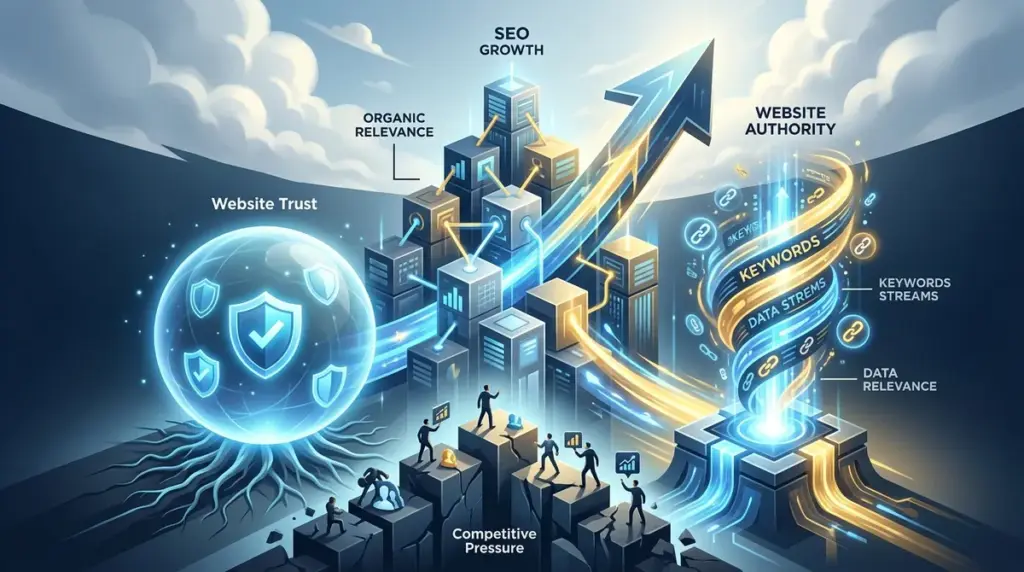
Search engines prioritize two distinct vectors when determining organic visibility: the strength of your backlink profile and the reliability of your information. While often used interchangeably, Website Authority and Website Trust represent different sets of algorithmic signals. Authority is your site’s power to compete for high-volume keywords based on its position in the global link graph. Trust is the search engine's confidence that your content is accurate, safe, and authored by a credible source. Understanding the difference between authority and trust is key to grasping what is website trust in SEO.
For site owners and SEO agencies, misidentifying which of these two pillars is lacking leads to wasted budget. Building more backlinks (Authority) to a site suffering from poor E-E-A-T signals (Trust) will not fix a stagnation in rankings during a Core Update. Conversely, a highly "trustworthy" site with no link equity will struggle to break out of page two for competitive commercial terms. Understanding the technical and strategic nuances between these two is the difference between a volatile site and a sustainable digital asset.
The Mechanics of Website Authority: Link Equity and Scale
Authority is a quantitative measure of a domain's influence. It is primarily built through external validation—other reputable websites linking to your content. In the eyes of a crawler, every high-quality backlink is a vote of confidence that increases your site’s "weight" in the index. This weight allows you to rank for keywords with high difficulty scores because your domain has the necessary equity to displace established competitors.
Primary drivers of Authority include:
- Link Diversity: A profile consisting of thousands of links from ten domains is less authoritative than a profile with one hundred links from one hundred unique, relevant domains.
- Link Velocity: The rate at which you acquire new links. A sudden spike can signal a viral moment or manual manipulation, while steady growth suggests organic brand expansion.
- Niche Relevance: A link from a high-DR fashion site carries less weight for a SaaS company than a link from a mid-tier technical journal. Relevance acts as a multiplier for authority.
Authority is effectively the "gas" in your SEO engine. It provides the raw power needed to move the needle, but it does not guarantee the direction or the safety of the journey. High-authority sites can still be demoted if their content quality or trust signals fail to meet modern search standards.
Defining Website Trust: Credibility and E-E-A-T
Trust is a qualitative assessment of a site’s integrity. While authority is about popularity, trust is about accuracy and transparency. Google’s Search Quality Rater Guidelines emphasize Experience, Expertise, Authoritativeness, and Trustworthiness (E-E-A-T), with Trust being the most critical component of that acronym. If a site is deemed untrustworthy, the other three factors become irrelevant.
Trust is built through "surrogate signals" that search engines use to verify your legitimacy. This includes everything from your "About Us" page transparency to the presence of a physical address and a clear privacy policy. In YMYL (Your Money or Your Life) niches, such as finance or healthcare, trust signals are weighted more heavily than backlink counts. A site with 50 high-quality, medically reviewed articles may outrank a massive forum with millions of backlinks but no editorial oversight.
Pro Tip: Do not confuse "Domain Rating" or "Domain Authority" with actual trust. These are third-party metrics that only measure link strength. A site can have a DR of 80 through aggressive link building while having a Trust score of zero in Google’s eyes due to deceptive affiliate practices or AI-generated misinformation.
The Critical Intersection: Topical Authority
Topical Authority is where trust and authority merge. It is the process of becoming the go-to resource for a specific subject matter. To achieve this, you must demonstrate a depth of knowledge that covers every facet of a topic, supported by an internal linking structure that guides users through a logical learning path.
When you achieve topical authority, search engines trust your domain to provide the "best" answer for a cluster of related keywords. This reduces your reliance on external backlinks for every new page you publish. A trusted topical authority can often rank for new keywords within hours of publishing because the domain has already proven its reliability in that specific niche.
Diagnostic Framework: Which One Do You Need?
Identifying whether your site lacks authority or trust requires looking at your ranking patterns. If you are producing high-quality content that never breaks into the top 50, you likely have an Authority problem. Your site simply doesn't have the "weight" to be taken seriously in a competitive landscape.
If your content consistently reaches the first or second page but then "tanks" or fluctuates wildly after a few weeks, you likely have a Trust problem. This indicates that the initial link equity got you to the table, but user signals (high bounce rates, low dwell time) or algorithmic checks (lack of author credentials, thin content) told the search engine that your site isn't the best destination for the user.
Trust signals to audit immediately:
- Author Bylines: Are your articles written by "Admin" or a verified expert with a linked LinkedIn profile and a history of writing in the niche?
- Fact-Checking: Do you cite primary sources and link to authoritative external data?
- Functional Transparency: Is your contact information, physical address, and terms of service easily accessible?
- Content Freshness: Is your information outdated? In trust-heavy niches, old data is considered a liability.
Balancing the SEO Budget: Strategic Resource Allocation
For a new site, the focus should be 70% Trust and 30% Authority. You must first prove you are a legitimate entity before you try to flex your muscles. This means investing in deep-dive content, expert contributors, and a clean technical setup. Once the "trust foundation" is laid, you can shift your budget toward aggressive link acquisition to scale your rankings.
For established sites that have plateaued, the strategy is often the reverse. You likely have the authority, but your trust signals have diluted over time as you’ve chased high-volume keywords outside your core competency. In this scenario, pruning low-quality content and reinforcing your topical clusters is more effective than buying more guest posts.
Executing a Trust-First Growth Strategy
To build a site that survives the volatility of modern search, you must treat trust as a technical requirement rather than a branding exercise. This involves a rigorous approach to how information is presented and verified on your domain.
Start by mapping your internal links to reflect a hierarchy of expertise. Every "money page" should be supported by several informational articles that demonstrate the "why" and "how" behind your recommendations. This creates a web of relevance that search engines can easily crawl and validate. Furthermore, ensure that your site’s technical health—HTTPS, fast load times, and mobile responsiveness—is flawless. Technical errors are often interpreted as a lack of professionalism, which directly erodes user and engine trust.
Finally, monitor your brand mentions across the web. Unlinked mentions on reputable news sites or industry forums are powerful trust signals. They tell search engines that your brand exists in the "real world" and is being discussed by humans, not just bots. This "offline" credibility is increasingly becoming a primary differentiator in an era of saturated digital content.
Frequently Asked Questions
Can a site have high authority but low trust?
Yes. This often happens with expired domains or sites that have used "black hat" link-building tactics. They possess a strong backlink profile (Authority) but lack the editorial standards or brand signals (Trust) required to maintain long-term rankings during core updates.
How long does it take to build website trust?
Trust takes longer to build than authority. While you can buy backlinks to boost authority in a few months, trust is earned through consistent publishing, positive user signals, and external validation over 6 to 12 months or longer.
Does social media following impact website trust?
Indirectly, yes. While social signals are not a direct ranking factor, a strong social presence leads to more brand searches and unlinked mentions. These are "surrogate signals" that Google uses to verify that a website represents a real, trusted organization.
Which is more important for a new website?
Trust is more important initially. Without a baseline of trust (E-E-A-T), search engines may "sandbox" your content regardless of how many links you build. Establishing yourself as a credible source allows your future authority-building efforts to be much more effective.