

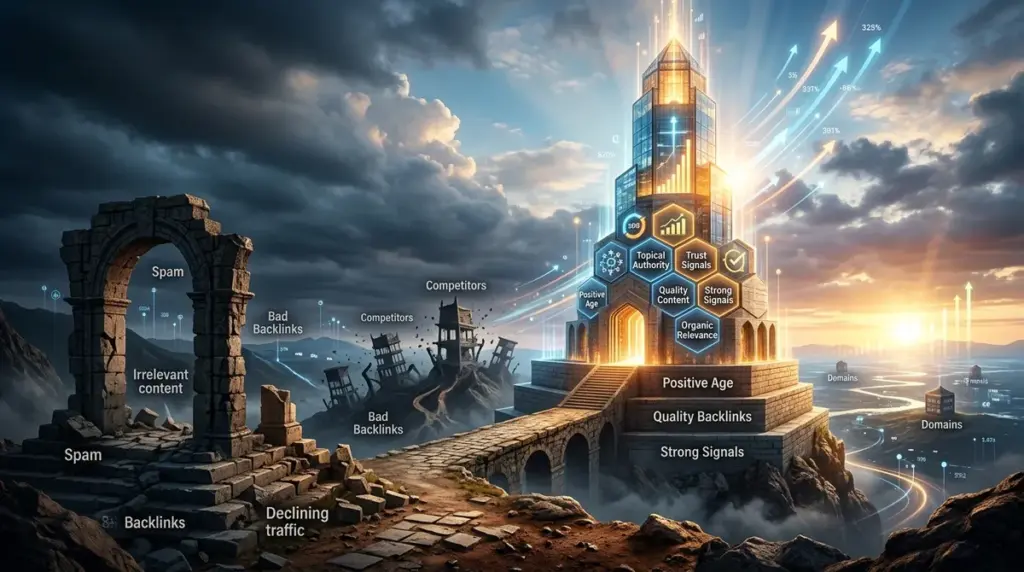
Buying a domain is rarely a clean slate. Every seasoned SEO knows that a domain’s past is a permanent ledger that Google references long after the previous owner has stopped paying the renewal fees. Whether you are acquiring an expired domain to jumpstart a project or auditing a client’s stagnant site, understanding domain history is the difference between a rapid ranking trajectory and a permanent algorithmic ceiling. Trust is not a metric you can see in a third-party tool; it is a cumulative score based on years of content consistency, link quality, and ownership stability.
The Persistence of Negative Link Equity
Google does not automatically flush a domain's history when the DNS records change. If a domain was previously used as part of a private blog network (PBN) or was blasted with low-quality automated backlinks to rank for high-competition keywords like "online pharmacy" or "casino," that toxicity remains. Even if the site has been offline for years, the backlink profile—the digital footprint of the domain—persists in search engine indexes. This toxicity remains, and it's vital to recognize the signs a domain has a weak reputation before acquiring it.
When you launch a new site on a tainted domain, you are inheriting its "bad neighborhood" status. Google’s algorithms, particularly those governing spam and link quality, may suppress the domain’s ability to rank for new, legitimate keywords because the underlying authority is built on a foundation of manipulation. This is why a domain with a lower "Domain Rating" but a clean history often outperforms a high-DR domain that has been cycled through multiple spam-heavy owners.
Topical Relevancy and the Re-Categorization Delay
Search engines categorize domains based on the content they have historically hosted. If a domain spent a decade as a reputable resource for "organic gardening" and is suddenly repurposed into a "SaaS reviews" site, there is a massive topical disconnect. This misalignment triggers a re-evaluation period where Google’s trust in the domain’s expertise, authoritativeness, and trustworthiness (E-E-A-T) is effectively reset to zero.
Impact on Crawl Budget: During this pivot, search engines may crawl the site less frequently as they struggle to reconcile the new content with the historical topical map. This often results in new pages taking weeks or months to index, regardless of their quality. To minimize this, practitioners must aggressively build new, topically relevant internal links and secure fresh, high-authority external mentions that align with the new niche.
Warning: Avoid domains that have undergone multiple "niche hops" in the last three years. Frequent changes in topical focus signal to Google that the domain is a "flipped" asset rather than a stable brand, often leading to a permanent suppression of organic reach.
The Critical Role of Whois and Ownership Stability
While many SEOs focus exclusively on backlinks, ownership history is a significant trust signal. Frequent changes in registrant data can be a red flag. A domain that has been owned by the same entity for ten years carries a weight of stability that a domain changing hands every twelve months lacks. When a domain is sold, Google may reset some of the accumulated "age" benefits, treating it as a new entity for a period of time to prevent the abuse of expired domains for quick ranking gains.
Key Indicators of Ownership Trust:
- Consistent Registrant Data: Long-term ownership by a single verifiable entity.
- Hosting Continuity: Stable hosting environments suggest a professional operation rather than a temporary site.
- Wayback Machine Snapshots: A visual history showing consistent site architecture and branding rather than drastic, sudden changes.
Identifying Historical Red Flags Before Acquisition
Due diligence requires looking beyond surface-level metrics. A high "Authority Score" can be easily faked with redirect loops and spammy link injections. To truly assess domain trust, you must perform a forensic audit of the domain’s timeline.
First, examine the anchor text cloud. If you see a sudden spike in foreign language anchors or keywords unrelated to the domain's primary topic, the domain has likely been compromised or used for spam in the past. Second, check the "Indexed Pages" history. If a site once had 50,000 pages indexed and now only has 50, it suggests a previous manual action or a massive de-indexing event due to thin content.
Best for: Agencies and investors looking at high-ticket domain acquisitions where the cost of failure exceeds the cost of a deep-dive audit.
Mitigating the Impact of a Tainted History
If you find yourself operating a domain with a checkered past, recovery is possible but resource-intensive. The primary goal is to "overwrite" the old signals with a high volume of high-quality, modern data. This is not achieved through volume, but through precision.
Start by using the Disavow Tool to aggressively prune the backlink profile. You should not just target "spammy" links, but any links that are topically irrelevant to your current mission. Following this, implement a robust internal linking strategy that emphasizes your new topical pillars. By creating a dense web of relevant content, you help the crawler re-map the domain's purpose. Finally, secure "trust-building" links from top-tier, industry-standard publications. These act as a digital character reference, signaling to Google that the domain is under new, reputable management.
Executing a Domain Trust Audit
To ensure your domain is an asset rather than a liability, follow this tactical workflow before committing to a long-term SEO strategy. The goal is to identify if the domain is "clean," "recoverable," or "toxic."
- Step 1: Use the Wayback Machine to verify that the site has never hosted adult content, gambling, or pharmaceutical spam.
- Step 2: Check the Google Transparency Report to see if the domain has a history of malware or phishing.
- Step 3: Analyze the historical organic traffic. A sudden, unrecovered drop to zero usually indicates a manual penalty rather than an algorithmic shift.
- Step 4: Verify the "Dropped" status. A domain that has expired and sat in a "parked" state for years loses more trust than a domain that was acquired via a direct transfer or auction while still live.
Domain History FAQ
Does domain age alone improve rankings?
No. Domain age is a secondary factor. A 10-year-old domain that has been empty or filled with low-quality content will not outrank a 1-year-old domain with high topical authority and a clean link profile. Age only matters when paired with a consistent history of quality.
Can I remove a manual penalty by letting a domain expire?
Rarely. Google’s index often retains the "memory" of a manual action. If you re-register the domain and the content footprint looks similar to the penalized version, the penalty is likely to be re-applied almost immediately.
How long does it take for Google to trust a repurposed domain?
Typically, it takes 6 to 12 months of consistent, high-quality publishing and clean link building for a domain to overcome a significant topical pivot or a period of dormancy. This timeframe can be shortened by securing high-authority mentions early in the process.
Is a 301 redirect from an old domain always beneficial?
Only if the old domain is topically relevant. Redirecting a high-authority "fitness" domain to a "tech" site can actually hurt your rankings by confusing the topical signals and introducing "link noise" that search engines may view as manipulative.